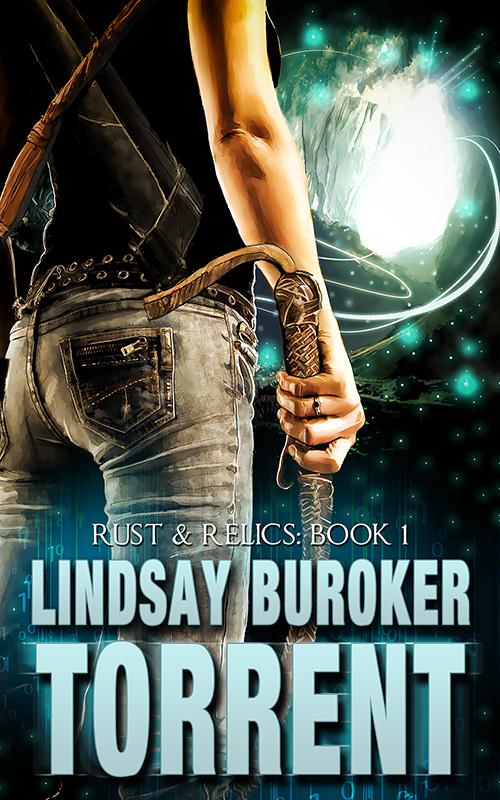
 I’ve been chatting it up on Twitter and Facebook, but here’s the official announcement: Torrent, the first book in a contemporary urban fantasy series, is available at Amazon, Barnes & Noble, Smashwords, and Kobo (Apple to follow in about a week).
Here’s the blurb and the first couple of chapters in case you’d like a preview:
When Delia chose to major in archaeology, she imagined herself as the female Indiana Jones of the Southwest. She didn’t imagine herself crawling through abandoned mine shafts, scrounging for rusty pickaxes and gold pans to sell on auction sites, but Indiana Jones didn’t have to make student loan payments.
Scouring the mountains of Arizona with Simon, her best friend and computer geek extraordinaire, Delia dreams of turning their scavenging enterprise into a legitimate business. More, she longs to earn the respect of peers who shun her for turning into a treasure hunter. What she doesn’t dream of is stumbling across a decapitated body in an old mine near Prescott.
Something dangerous has come to the mountains, and a pair of Harley-riding strangers are the only ones who seem to have a clue. They speak a language Delia has never heard and carry mysterious artifacts she’s never seen. Investigating these strangers might lead her to discoveries that change the face of archaeology forever… or it might lead her and her best friend into a deadly monster’s lair.
Chapter 1
You get yourself into strange places when you’re broke, jobless, and trying to figure out how to pay back sixty thousand dollars in college loans. Such as dark, musty mine shafts that have been abandoned for a hundred years.
“Not to sound like a belligerent seven year old in the back of the car, but how much farther?” I asked and wiped my nose.
You wouldn’t think anyone’s nose could run in Arizona’s 1.37% humidity, but my nostrils were coated with dust, microscopic shards of stone, and the remains of that bug I inhaled on the off-off-road drive up here. Somehow, when I’d been studying archaeology at ASU and picturing myself as the female Indiana Jones of the Southwest, I hadn’t made allowances for the bug guts.
“We’re close,” Simon said, “I promise.”
He was leading the crawl through the doddering old mine, and there wasn’t enough room for me to scoot up beside him. That made him fortunate, because if I could see his smartphone and the app that was supposedly leading us to this treasure, I’d probably discover there was no reception down here and that he was making “educated guesses” again. At that point, I’d be obligated to punch him, Yaiyai’s lectures about proper ladylike behavior notwithstanding.
“Close as in just around the next bend?” I asked. “Or close as in the it-can’t-be-that-far-to-the-Winslow-rest-stop incident?”
Simon grinned back at me, his bronze face grimy, his short black hair full of dust, and his headlamp blinding me. “Delia, I promise we are much closer to our destination than we are to Winslow, Arizona.”
“How comforting.”
He winked, reminding me for all the world of Coyote from the Navajo legends, though, as he’s quick to point out, the Makah are about as closely related to the Navajo as Norwegians are to Greeks.
Simon glanced at the display on his smartphone, then shuffled forward again. I gave the splintered supports above our heads a wary glance, then followed after him.
“There’s an open area ahead,” he said. “This might be what we’re looking for.”
Despite my grousing, anticipation flowed into my limbs, and I crawled faster, ignoring the dirt and gravel slipping past my belt to fill my jeans and underwear with gritty souvenirs to discover later. Simon scrambled down a slope into a relatively flat space where he could stand.
His head rotated, his lamp beam sweeping across the area. “Hm.”
That hm didn’t sound particularly exultant. When I scrambled down the slope and came to my feet beside him, I was underwhelmed.
“Lo, a broken shovel haft,” I said, raising an arm in triumph. “Finally, the rare relic that will make our business famous, bring in clients with lots of money, and earn me the respect of peers who’ve shunned me since I embarked on this dubious career.” My sarcasm grew a little raw there at the end, and I reminded myself that I’d chosen to give up the legitimate job, so complaining wasn’t seemly.
“Did you say lo?” Simon asked.
“Not in any sort of seriousness.”
“Oh, good. I was afraid I’d have to tease you relentlessly for the rest of the day.” He picked up the shovel haft and knocked dust off it. It might be a hundred years old, but even in pristine condition, it wouldn’t be an item that collectors sought.
“There’s no iron on it,” Simon said. “This isn’t what the metal detector picked up.”
I eyed the dirt ceiling again. Not for the first time, I wondered if he’d simply chanced across bottle caps buried in the rocky hillside above, but he’d assured me on multiple occasions that the Dirt Viper was accurate to fifty feet, not only at finding metal, but at displaying its depth. It ought to be. We’d paid thousands for the thing. Add that to the subterranean explorers app he’d made, and we ought to be the premier treasure hunters of the Southwest. Thus far, though, he’d made more money for the business by selling copies of the software, and I’d made more by bargaining for arrowheads and antiques at estate sales.
“Let’s see what’s over the next rubble pile,” I said, continuing forward. At least, I tried to continue. Something tugged at my waist, and I stumbled.
The bullwhip I wore on my belt had unraveled, the tip catching in the rocks. It was probably a silly accoutrement for a treasure hunter who rarely crossed pits of snakes or fled from giant boulders, but it came in handy often enough that I endured the mocking I got from friends, family, and airport security. I grumbled and returned to extricate it while Simon laughed.
“You’re supposed to assist a woman in trouble, not snicker at her.” I pointed a finger at his nose. “This is why you have a hard time getting girls.”
“Really? I thought it had more to do with my scrawny limbs, passion for all-weekend RealmSaga sessions, and pathological inability to speak to women without stuttering.”
“No, it’s definitely the inappropriate snickering.” I freed the bullwhip and looped it again on my belt opposite the multi-tool that completed my adventuring ensemble. “A girl likes to know that you support her and—”
A shriek rang out of the darkness. I jumped so high I nearly cracked my head on the tunnel support.
“What the—?” Simon asked.
I would have asked something similar, but I was too busy clutching my chest and wondering if one’s heart really could leap into one’s throat. It’d been so silent since we entered the passage that I was surprised to learn anyone else was on the same mountain, much less in the same mine. And apparently in distress. Or pain. Male? Female? I couldn’t tell. The scream rang out again.
I jogged for the rock pile and climbed a couple of feet, shining my headlamp into the darkness ahead. “Do you think we can get there from here?”
“Er.” Simon hadn’t moved. The whites of his eyes were visible around his irises.
I frowned back at him. “What’s the hold up? Someone’s in pain.”
“It sounds like someone’s being attacked. The closest thing to a weapon I have is an app that makes machine gun noises.”
“Don’t be silly. Attacked by what? Someone must have fallen into a pit or something and needs help.”
The scream came again, much weaker this time, almost a whimper.
I crawled higher up on the rubble pile until my head almost bumped against the ceiling. On hands and knees, I advanced atop the gravel and boulders, not certain if the tunnel continued or if I’d run into a dead-end. I was relieved when rocks shifted behind me, announcing that Simon was following. Despite my certain words, I didn’t truly want to crawl deeper into the mine alone.
We shuffled across the top of the rubble-filled tunnel in silence for a few minutes. The scream didn’t come again. I wondered if we were going in the wrong direction, but there’d been no other alternative routes, at least not from the mine shaft we’d entered through. It’d been so hidden behind tall grass and manzanita that I wouldn’t have thought anyone had traipsed through it for years if not decades. But we couldn’t be the only… explorers—my mind shied away from labeling us as scavengers—out here.
“Stop,” Simon whispered.
“What is it?” I halted, turning my face left and right to probe the darkness ahead with my headlamp.
“Do you smell… I swear I caught a whiff of blood.”
At first, I thought he might be joking—what did he think he was, a bloodhound?—but the dusty air did have a different scent. Blood? I wasn’t sure, but the memory of elk hunting with my grandfather came to mind, so maybe so.
“He could have gotten some cuts…” I said, though I’d grown less certain of my fall-in-a-pit theory. What kind of pits would there be in mine shafts, anyway?
“I’m glad you’re leading the way,” Simon muttered.
I continued forward, keeping my eyes trained on the darkness ahead. “You’re not living up to all those stories about Native Americans being brave warriors.”
“You’re thinking of the Comanche. My people have always been peaceful fishermen. We rocked at throwing parties and giving gifts too. You’ve heard of potlatches, right? If you want me to make a gift for whatever is attacking that person, I’ll be happy to do so.”
Usually his chatter made me smile, but I found myself licking my lips and wondering if we should leave. I hadn’t heard a peep in several minutes. Maybe it was too late. Or maybe we could pretend we’d never heard anything to start with. Despite the cowardly thoughts, I kept going. If we ended up injured or in trouble on one of our excursions, I sure hoped someone would come help us.
The rubble pile sloped downward until I could stand again. Ore cart tracks came into view, as well as our first branch in the tunnel system. Three options stretched before us, all dark. I thought we might spot some footprints, but rocks and gravel dominated the ground, nothing that held tracks.
“Got an app that can tell us which way?” I asked.
But Simon had tucked away his smartphone. He sniffed the air a couple of times, then pointed to the leftmost passage. I tried a few experimental sniffs myself. That faint taint of blood or meat still hung in the air, along with… It almost smelled like the ocean. Salt? Seaweed? Odd. We were a six-hour drive from the Pacific.
I was tempted to make Simon go first since he’d picked the route, but he truly was unarmed. At least I had sharp, pointy things on my multi-tool. And I’d taken those three years of Tae Kwon Do during college. Both of which were sure to be useful against a pack of rabid wolves.
Ahead a support beam had broken and lay diagonally across the tunnel. Before clambering over, I peered under it, half expecting the person who’d screamed to be crumpled there, but the passage beyond was empty.
His eyes on the tunnel ahead, Simon climbed past the timber and continued into the darkness. I caught up with him when he stopped. The shaft had ended, opening up into a natural cavern. My headlamp beam played across stalactites and mounds of rock. It reminded me of the Colossal Cave near Tucson, if a smaller version. But there weren’t supposed to be any caves in the mountains around Prescott, at least not that I’d learned about when researching the area online. We weren’t on private property—this was part of the national forest—so it was hard to imagine something like this not having been turned into a tourist trap. Maybe, like the rubble-filled mine shaft, it wasn’t structurally sound enough. I grimaced at the ceiling.
Simon must have had something besides tourist traps on his mind, for he wandered into the cavern, climbing over mounds and slipping past stalagmites. He stopped, his back rigid.
“Find something?” I asked casually, though my heart rate had quickened.
“Yeah.” His voice came out choked.
I summoned some fortitude and climbed over the rocks to join him. The scent of blood—of freshly butchered meat—grew stronger, and so did the smell of the ocean. Before I could remark on the weirdness of the seaweed odor, I saw what had made Simon halt.
It was a young man’s head. Just a head.
It’d been removed from his body, the severing gory and uneven, as if it’d ripped off with one’s bare hands, if anyone’s hands were strong enough for that.
Mutely, Simon pointed to the side. A few meters away, crumpled between two mounds of rock, lay the rest of the body, a khaki shirt torn and saturated with crimson. Blood pooled beneath the torso, blood that hadn’t yet had time to dry.
Chapter 2
I stared at the body for a long stunned moment, then stumbled backward, my stomach roiling. I closed my eyes and pressed a fist to my mouth, struggling to tame my gag reflex. I needed to figure out what was going on—and if we were in danger—not throw up all over a crime scene.
“You don’t know it’s a crime,” I muttered to myself. It was hard to believe someone could have accidentally been decapitated, but maybe there was some kind of… natural explanation.
But what if whatever had done this was still in here? We’d heard the man scream not ten minutes ago. I peered about the dark cavern, my headlamp doing a pitiful job of illuminating its recesses. Nothing stirred in the depths of the chamber, and I didn’t hear anything except my own breathing. Odd how loud that can sound in utter silence.
Simon was staring at the body, his headlamp unmoving. He wasn’t in shock, I didn’t think, but horrified. He started eyeing our surroundings too.
The dead man—what was left of him—wore a backpack with a coil of rope strapped to it, though neither item had been removed. I pointed my lamp upward. Maybe if he’d dropped from above and onto a sharp cave protrusion… but there was nothing to fall from, nor were there any gore-covered rock features. Besides, people’s heads didn’t get torn off when they fell. I rubbed my face with a shaking hand.
A flash of light assaulted my eyes, and I lurched sideways into a stalagmite. Simon was snapping pictures.
“What are you doing?” I whispered harshly. All right, that was obvious. What I meant was… “Why are you doing it?”
“There’s a smudge here, like part of a bloody footprint. Or paw print.” He shrugged.
“You shouldn’t be standing that close. Your foot is in blood, that guy’s blood.” That disturbed me almost as much as the presence of the body for some reason. I’m sure it was the only reason there was a hysterical edge to my voice. “Don’t touch anything. We’ll go tell the rangers.”
Simon lowered his phone to frown at me. “The rangers? You think they’re up for murder investigations?”
“This isn’t a murder. This is a… a… mauling. By… a… bear.” I didn’t believe that—I’d seen bear work before, and tearing heads off people wasn’t their style—but I wanted to believe it. Bears were normal. Normal was good. Or at least—I glanced at the body again—less disturbing.
“A bear? You… believe that?”
“You tell me,” I said. “Didn’t you spend your youth close to nature, learning to hunt and track and identify what bodies mauled by bears look like?”
“If by close to nature you mean living in a trailer, playing computer games, and making spaghetti and meatballs for my addled grandmother, absolutely. As to the rest, the only thing bears in the Pacific Northwest maul are salmon, so I wouldn’t really know. These”— he waved at the cave, or maybe at the mountain or the entire state, “—are your stomping grounds.”
I pushed my bangs out of my eyes. Technically, I was from New Mexico, not Arizona, but he was right. I’d grown up in a similar climate, and I was the one with the self-sufficient back-to-the-earth family, including a grandfather who’d taken my interest in shooting bows for a desire to learn how to hunt. I’d been so impressed that he’d been willing to take me out to do “boy” things that I hadn’t admitted to the amount of puking I’d done the first time we shot an elk. I’d been more relieved than chagrinned when Yaiyai insisted that young women who wanted to get married and make babies shouldn’t be running around in the desert like savages.
“I don’t think it was a bear,” I finally said, then crinkled my nose. The queasiness hadn’t left my stomach, and the longer we stayed in the confines of the cave, the more the smell of the body was getting to me, not to mention the terror forever burned into the man’s eyes. “Let’s argue about it elsewhere, all right? After we tell someone. If not the rangers, the sheriff’s department.” All I knew was that we weren’t investigating it.
“Whatever you say.” Simon’s phone ticked as he claimed a few more pictures.
I grabbed his arm and propelled him along with me. An uneasy sense of foreboding crept over me as we headed back for the mine shaft. “What are you planning to do with those pictures?”
“Nothing.”
“Why don’t I believe you?”
“You’re mistrustful by nature,” Simon said.
“Or I’ve known you too long. I’ve never seen you snap pictures unless it’s to gross out your brother or to post something for the company blog.” I scowled at him. “And this better not be about the latter.”
“I wouldn’t put pictures of bodies on our business site.”
“Good.” I climbed back up the slope of rubble, eager to see the sun again.
“But,” Simon said, “if we had evidence about the existence of some mutant animal or weird desert monster, it’d bring tons of traffic to the site.”
I nearly stumbled down the back side of the slope. “Simon.”
No way was I going to let him put something that sensational up there.
“Well, it totally would,” he said.
“We don’t need prepubescent boys who want to gawk at dead people coming to our site. They’re not our demographic.”
“You never know. Besides, any links that we can get to the site from big bloggers and newspapers will help us out. The search engines will love us and send more traffic overall. Relevant traffic.”
I waved, trying to silence him before he started explaining search engine optimization to me. Again. It’d made my eyes glaze over the first time. Nor should we be discussing marketing strategies when some guy was dead back there.
A moan whispered through the tunnel.
I swallowed. “What was that?”
“The wind?”
“Underground wind?”
“It could be blowing over a hole leading to the outside somewhere,” Simon said.
“It sounded like it came from behind us.”
I wanted him to tell me I was wrong, to convince me of this wind theory of his, but he didn’t say anything else. His fingers brushed my boot though. He was crawling along the rubble more quickly now. I picked up my pace too.
We scrambled down from the rubble pile and into the chamber where we’d found the old shovel haft. A clunk, clunk, thud sounded somewhere behind us. A rock falling. One we’d shaken free in our passing? Or had something else shaken it free?
“Go,” Simon urged, giving me a push.
“Good idea.”
He passed me and surged up the next rubble pile.
I charged after him. “Oh, sure, now you’re willing to take the lead.”
He didn’t answer. We were too busy scrambling across the rocks, our breaths loud enough to hear. Another rock fell behind us, maybe twenty meters back. One rock might have been chance, a delayed shifting after our passing, but two?
I whispered a few curses at the noises and at the scrapes my elbows and knees were taking. I skidded down another slope, glancing back before dropping below the top of the rubble. The glance was too wild—too quick—causing the headlamp’s beam to blur about. There might have been a dark shadow back there, something moving, but I couldn’t be sure. I wasn’t about to stop for a longer look.
When we hit the ground, hard rock lined with ore cart tracks, our crawls turned into sprints. How far was the exit? A quarter mile? On the way in, we’d been going slowly and exploring, so I wasn’t sure. I urged my legs to greater speed, though, hoping to see the light at the end of the tunnel. I also hoped man-slaying tunnel monsters didn’t like light. Surely the harsh Arizona sun would melt such a creature or turn it to stone or—
Another moan, this more of a growl, emanated from the darkness behind us.
I cursed again. Not only was that not the wind, but it was closer this time.
“There,” Simon panted, flinging his arm out. He was a few feet ahead of me and had seen the light first.
As soon as the tunnel entrance came into view for me, I summoned all of my remaining strength for a last sprint. My thighs burned and the air rasping into my lungs didn’t seem to do any good, but I kept running nonetheless. My eyes focused on the mottled sunlight slanting through the grass and leaves and onto the dusty rocks by the entrance. I raced toward it… then through it, ignoring the branches clawing at my face and my hair.
The mine shaft opened onto a slope, and my momentum carried me down the mountainside with huge lunging steps. It was only luck that I didn’t trip and roll headfirst down the hill. I spotted a towering pine at the base of the slope, the nearest branch more than fifteen feet up. Without slowing, I tugged my bullwhip free. With an arm lift and wrist snap that I’d practiced countless times on bottles in the yard as a kid, the popper wrapped around the branch. I’d practiced using the whip as a rope far fewer times, but with adrenaline surging through my limbs, I scampered up it like a squirrel racing up a tree. I didn’t pause to look around until I stood on the branch with my arm clamped to the tree trunk.
The mountainside lay quiet, bathed in late afternoon sunlight. No birds chirped, no cicadas buzzed, and no bears, monsters, or other nefarious predators tore down the slope toward my tree. I didn’t know if the forest critters were being quiet because they’d sensed danger or if our rapid charge out of the mine shaft had startled them to silence.
Simon was leaning against a bolder, looking at my tree. When our eyes met, he arched his brows.
“Nice move with the whip,” he said. “If you give up antiquing as a job, maybe you could get a stunt double gig in Hollywood.”
“Har har, don’t tell me you weren’t scared. I was the one trying to keep up with you.”
“My canteen was low, so it seemed like a good time to leave and replenish my supplies.” Simon smiled ruefully. “At top speed.”
“Uh huh.” I shifted my weight so I could sit on the branch. It wasn’t a comfortable perch, but I wasn’t ready to leave it yet. I might have imagined that something was following us—though I had heard those noises back there, I was sure of it—but either way, something ghastly had happened to that climber. I unwound my whip so I could coil it on my belt again.
“We should get off this mountain before dark,” Simon said. “Zelda barely made it up here in daylight.”
“Good idea,” I said, though I waited a couple more minutes before climbing down. By then, a few birds had started chattering again. Despite our jokes, we navigated through the dry brush at a quicker pace than usual. Neither of us would feel safe until we were back on a paved road close to civilization.
Our pace picked up even more when Zelda, our battered blue Volkswagen Vanagon came into view, our business name, “Rust & Relics” painted on the side in white with my cell phone number and our web address. I was relieved to see the van, but that relief disappeared when we rounded the back and found the side door wide open.
“Uh,” Simon said.
“Did you leave that open?” I asked.
“No. You?”
“Would I be asking you if I’d done it?”
“I thought it might be a trick question,” Simon said, considering the ponderosa pine trees around us.
Needles littered the dry forest floor, but there wasn’t much undergrowth where someone might be hiding. I peeked inside the camper to make sure nobody lurked in there either. The table was set up, as we’d left it, with Simon’s half-eaten carrot still sitting by the sink. I didn’t see anyone up front or under the seats, nor did anything significant appear to be missing. Outside, numerous footprints marked the dusty earth around the door. I knelt and probed one of the more complete prints. It’d been made by a boot. I was wearing beat-up trail-running shoes while Simon sported his typical socks with Birkenstock knock-offs. How he ran in sandals, I couldn’t guess. At that moment, all that mattered was that neither of us was wearing boots.
I pointed wordlessly at the prints. Was it possible a human being had killed that man? It was hard to imagine, but perhaps with a tool, one could rip off a head. An awful, awful tool…
“Two sets,” Simon whispered. Eyes toward the dirt, he started following them.
“Are you sure you want to do that?” I asked.
“Find the asshats who were poking into our van? Yeah.”
“What if they’re the same asshats that did that?” I jerked my chin toward the mine and the body within.
Simon halted, one foot in the air. “Oh. I was imagining teenagers.” He set his foot down and considered the earth again. “The prints aren’t any bigger than mine. I wear a nine. Do you really think someone my size…?”
Simon was only a couple of inches taller than I am, maybe 5’8”, and with his slender build, weighed less than I did, a fact I didn’t advertise, though it’s hardly my fault that girls have extra curves that account for these discrepancies. The point was that Simon would be lucky to bench press his own weight—tearing heads off was out of the question. With his bare hands anyway.
“They might be just like you,” I said, “the sort of kids who got stuffed into their lockers repeatedly in school, thus giving them both the lust for revenge and the quiet time spent in confined solitude required to come up with megalomaniacal plots to take over the world with computers.”
Simon propped a hand on his hip.
“Before you try to tell me that you weren’t like that in school,” I said, “I’d like to remind you that you’re wearing an Apple T-shirt from the 80s.”
“I was just going to say that there’s nothing you could do with computers that would tear off someone’s head.” He lowered his hand. “Robotics maybe.”
“Right, let’s get out of here.”
Simon started to turn away from the slope where the prints were headed, but halted midway. “Wait, there’s something shiny up there.”
“Sure, and good things always happen when people wander off after shiny objects,” I muttered, but I followed him up the hill anyway. I had the keys to the van, but he had the detailed terrain maps on his phone, so I had better keep him out of trouble. I wasn’t positive I could find my way back through the maze of forest service roads we’d traveled on my own.
We didn’t need to go far before the shiny object came into view. Two shiny objects actually, though they were almost as dusty as the van, so it was surprising he’d spotted them. The black Harleys rested in the shade of a pine. The only sign of the owners were two black helmets hanging from the handlebars. The bikes had Montana license plates. Not the expected birthplace of megalomaniacal robotics geeks, but one never knew. I took out my smartphone and snapped a picture of the plates.
“Maybe we should do something to delay them,” Simon said. “Keep them from following us, you know? We could siphon the gas out of their tanks or do another… thing that would require them to make repairs.” His scrunched brow suggested he didn’t know what that thing might be.
“I’ll let you figure out how to do that if you don’t mind hiking back to town.” I wouldn’t leave him, and he knew I wouldn’t leave him, but I said, “I’m getting out of here.” Anything to hurry him along. I wanted to get off this mountain before… I shook my head and rubbed at the gooseflesh that had arisen—or perhaps never completely left—on my arms. It was a warm autumn day, but I wasn’t feeling it.
I jogged back to the van, threw the sliding door shut, and jammed the key into the ignition. Fortunately, Zelda was in a good mood and started on the first try. I performed something that should have been a three-point turn in about ten points, thanks to the copious boulders, logs, and stumps surrounding our parking spot, then leaned over and pushed the passenger door open for Simon.
He trotted out of the trees and hopped in. “How’d you know I’d be right down?”
As soon as he shut the door, I started down the hill. “Because when we got stranded in Allie’s new car before graduation, you asked if putting up the hood would void the warranty. I imagine we’d have to be in some crazy alternate reality for you to know how to effectively sabotage a motorcycle, car, truck, or skateboard.”
“Shows what you know.” Simon pulled out a Swiss Army Knife. “I jabbed a hole in the tires.”
I gaped at him. “Did you really?”
“I’m hoping they’ll still be stuck up here when the sheriffs and rangers arrive.”
“Then I’m hoping they weren’t bright enough to get our license plate number. Or our business name that’s printed on the side of the van. Or my cell number. Damn it, Simon, if any creepy mouth breathers call me, I’m making you talk to them.”
He had the grace to look sheepish at the possible ramifications to his impetuousness, but only said, “Fine. I’m going to see if anything’s missing.”
As he poked around in the back of the van, I began plotting escape routes out of Prescott. For a touristy mountain town, it was a decent size, but not so big that I thought we’d be safe from anyone cruising along the roads, looking for a blue Vanagon.
“Bastards,” Simon grumbled, his voice muffled. He had his head stuck into the storage area under the long seat that pulled out into a bed.
“What’d they take?”
“The Dirt Viper.”
I groaned. “The we-have-to-spend-thousands-of-dollars-that-we-can’t-really-spare-to-get-a-quality-metal-detector Dirt Viper?”
“Yeah.”
I almost complained that we were having the worst luck ever, but the memory of the dead man flashed into my mind, the image more sobering than a gunshot wound. Someone had experienced much, much worse luck that day….
~
If you’re a fan of urban fantasy, monsters, and snarky characters, you can grab the rest of the novel at Amazon, Barnes & Noble, Smashwords, and Kobo. Thanks for reading!