Latest Story News + a Bribe :)

For those who are curious about such things, I thought I’d post an update (and a bribe — more on that below). I have several projects in the works and will have something new out in December (and probably January and February as well!).

Next up will be a series of three prequel novellas for the Nuria trilogy I’ve been talking about. The first one will be free, though it may be via a coupon code, so make sure you’re signed up to my newsletter to get it. After that, I’m planning to finish the half-written Flash Gold 4 and my contemporary mystery/romance. While all of this is going on, I’m working on Republic (working title), a novel that takes place a few months after the last book in the Emperor’s Edge series.

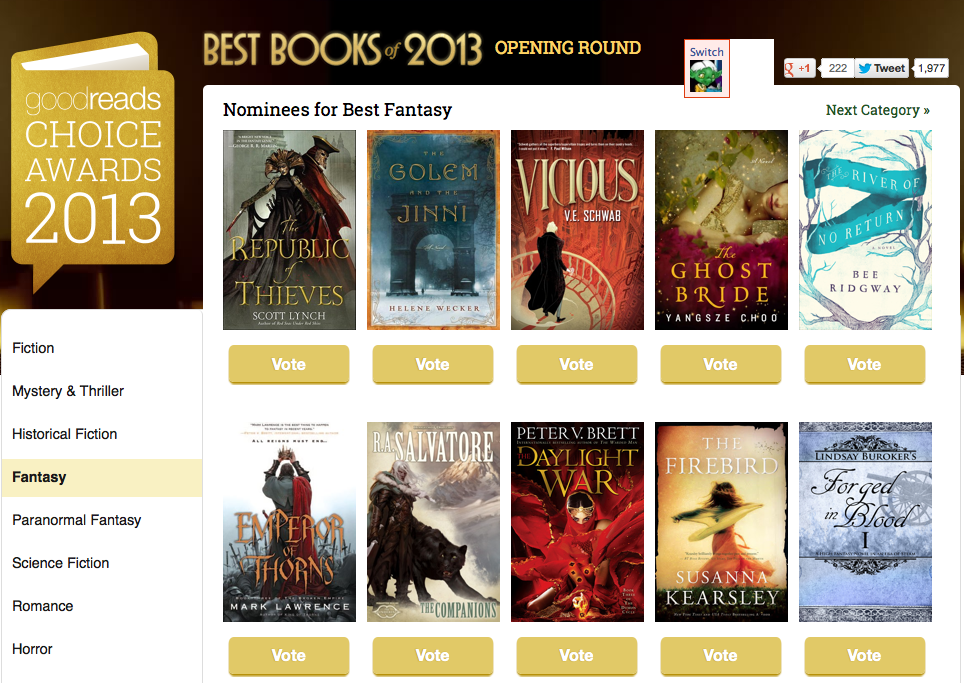
In other news, Forged in Blood I has made it to the semifinals over in the Goodreads Choice Award Contest. If you’d like to vote for it, you can do so here.

I know it doesn’t have a shot at winning, but if it makes it to the finals, I’ll write a new Emperor’s Edge short story for Christmas and post it here for everyone to enjoy. I’ll do a quickie vote to see if you guys want the story to focus on Amaranthe & Sicarius (a tropical island Solstice Fest?) or someone else in the gang.


Posted in News | Tagged , | 26 Comments

The Art of the Amazon Sale: Improving Rankings, Selling More Books, and Gaining Exposure

I’m not a master marketer. I never hand someone a business card unless they ask, I rarely plug my titles on Twitter and Facebook, and if I had to sell my books face-to-face I doubt I’d have moved more than ten copies in the last three years. But with Amazon, if you can figure out how to sell moderately well, the company’s algorithms tend to reward you by promoting your books beyond what you could have done on your own (via Top 100 lists, also-boughts, and emails to readers who might be interested in your title). It’s worth it to tinker around over there and try to make things happen, even with a series where you’ve long since released the last book, and sales have started dwindling (especially with such a series).

Running sales is a way to create interest in your books among new readers, so long as you’re willing to do a little promotion (which may be as simple as buying an advertisement) in concurrence with these temporary price drops. I personally haven’t seen much of a sales difference from simply dropping the price without making announcements and increasing my promotional efforts.

How I ran my last sale

For my latest promotion (just a few days ago), I took out a Bookbub ad to plug the first book in my Emperor’s Edge series, which has been free for the last couple of years. It’s hard to run a “sale” on a book that’s already free (more on the true sale coming up), but any time you can increase the visibility of a perma-free title, it’s an opportunity to get more people into your world, and that’s a good thing.

That said, I had run a Bookbub ad on EE1 before, and I wasn’t sure how many downloads it would get this time around. I hoped at least some people on the company’s fantasy list would be new, and I thought it might still get a couple thousand, enough to bring it back up to #1 in free fantasy for the day, something that would give it some new visibility at Amazon for readers who hadn’t chanced across me before.

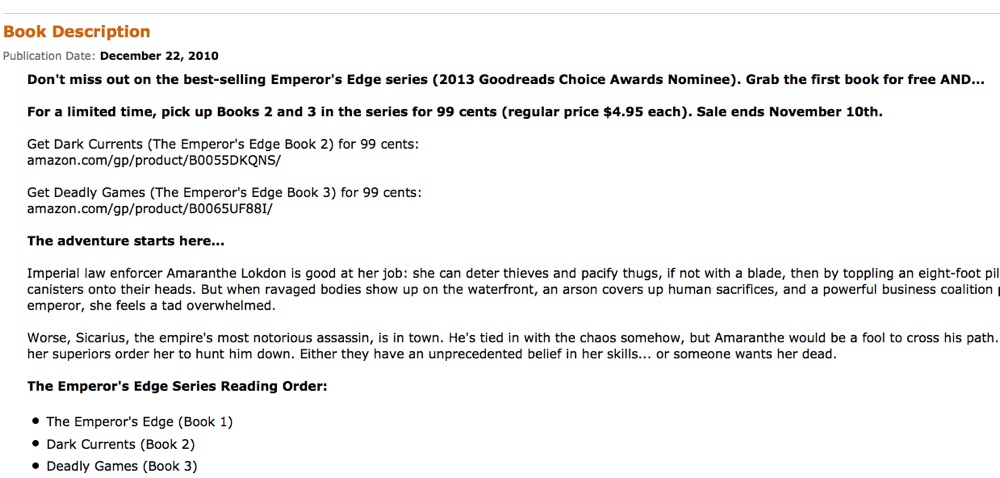
To make this a true sale, I decided to also drop the price of my second and third books to 99 cents for the weekend (the Bookbub ad ran on the 7th, and I left the other books at 99 cents until the 10th). 35 cents (what you make on a 99-cent ebook sale) per copy is kind of meh, but since I have seven books total in that series, I figured I could still do well if readers got into the series and went on to buy the others (my regular price is $4.95 for each novel, earning me $3 and change per sale). Also, I thought that by pricing Books 2 and 3 at 99 cents — for a limited time — some folks grabbing the freebie might pick up those on the same day, rather than waiting to read Book 1 first. With three of my books on their kindles, I also reasoned that they’d get around to trying my series sooner rather than later (one wonders when and if freebies will get tried when they’re downloaded by Bookbub readers, because those guys get free book offers every day).

I made sure to announce that Books 2 & 3 were on sale in the blurb area for Book 1, the book that everyone was popping in to check out. Here’s a screenshot of what that looked like (click for a bigger picture):
Book-1-freebie-bookbub-sale

In the blurbs for Books 2 and 3, I also announced that the novels were on sale, making sure to point out that the regular price was $4.95 and that the sale would end in a couple of days. I’m never sure how many sales tricks I want to use to tweak the copy (I have an aversion to used-car-salesman tactics), but I’ve read various marketing studies that show people are more likely to act (buy) when there’s a chance they might lose something than when there’s a chance they might gain something. So I tried to emphasize that with the words “don’t miss out” and “for a limited time.” I’m sure lots of people see through those gimmicks, but, hey, you never know!

Results

I’ve been at the top of the fantasy charts before (with new releases) and have never taken off in a huge way, so I didn’t expect that this time, but I did well overall with the sale and more than recouped my money on the $90 ad (advertising a free ebook on Bookbub is the least expensive way to go — their sliding scale means it costs more, and in some genres a lot more, for books discounted to 99 cents or $2+).

On the day the ad ran, The Emperor’s Edge was downloaded about 6500 times (remember, I’ve advertised to this list before so you might very well get more downloads for a new fantasy freebie), enough to get it in the Top 20 free overall and enough to keep it at #1 in the epic fantasy free category until Sunday morning (the ad ran on Thursday). As I write this on Tuesday afternoon, it’s still at #3 in epic fantasy and 255 overall. It’s now been downloaded about 10,000 times since Thursday morning. (It had only been downloaded about 200 times in the week prior, November 1st to November 6th).

Before running the ad, I was selling less than 10 copies a day each of Books 2 and 3 in the Amazon US store, and each had 50-odd sales at the time of the ad (books at full price). Between the 7th and the 10th (the days of my sale), both titles sold more than 550 copies each, and both jumped into the Top 20 of the epic fantasy paid listings for about three days (these are books that had been out for two years and that hadn’t been anywhere near the Top 100 in quite some time). About half of those sales came on Day 1 of the ad and were probably Bookbub people, but I’m guessing about half of them simply came from people who saw the 99-cent books in the charts (or who saw EE1 at the top of the free chart) and decided to give them a try because of the low price.

So, have I made a ton of money? Well, not really, since I only get 35 cents per sale on those 99 cent books, but I made about $400 minus the $200 or so those books would have made if they simply sold their average number of copies per day at full price and minus the $90 for the ad. So, I came out ahead by about $110 for the weekend.

And, of course, there are the less tangible benefits:

  • I’m already seeing an uptick in sales in the later (full-priced) books in the series, and expect that trend will continue for the next month or so, as people get through the first three books and decide to go on.
  • More readers are checking me out right now (sometimes the pure math doesn’t look that good with these 99-cent titles, but when it comes with an increase in sales — more people trying your books — it may mean that you gain more long-term fans who will stick with you for future books).

This is the first time I’ve run sales on following books at the same time as advertising my perma-free title, and it’s something I’ll definitely do again. This way I got to break even on Day 1 rather than hoping people who picked up the freebie would eventually try the other books in the series. I also got to spend less on the ad than I would have to promote a 99-cent title.

I should point out that on Barnes & Noble, where I couldn’t change the blurb text on the free book (because it’s free via Smashwords, and it would have taken too long for the update to filter through), I only sold about 25 extra copies each of the 99 cent titles over the weekend.

But what if I can’t get into Bookbub?

I know, I know, everyone loves Bookbub because it makes it much easier to run an effective sale on Amazon, but for those who can’t get in (they’ve gotten picky about what they accept) or who don’t have the money to buy one of their slots, you can also opt for less expensive advertising sites (here’s a KBoards link where someone listed a bunch of sites that accept freebie/bargain books) or just plan do a bunch of extra legwork on the social media sites during your sale.

A lot of authors are going in together right now (i.e. ten people selling ten thrillers for 99 cents), so it’s a group effort for promotion. This lets you reach a lot more people with less individual work. Some people with series are even putting their Book 1s together into box sets to sell on Amazon for 99 cents, so readers get a great deal and can try a number of new authors at a time.

Just remember that you will probably need to do more than drop your book to 99 cents (or whatever your sale price is) to increase your numbers.

Lastly, don’t forget to change your blurb to let people know that the book is on sale until Date X and what the regular price is (for those in KDP Select, you can make things easier by using Amazon’s new Kindle Countdown Deals). You’ll probably want to change the blurbs via Author Central rather than the KDP dashboard, as you can add bold, italics, and bullet lists that way.

That’s it from me. If you’ve run your own sales and had good results (or even if things didn’t work out as you’d hoped), we’d love to hear about it. Please comment below.
 

Posted in Advertising, Amazon Kindle Sales, Book Marketing | Tagged , , , , , , , , , | 24 Comments

Forged in Blood I Nominated for 2013 Goodreads Choice Award — Thanks!

Screen Shot 2013-11-04 at 10.48.52 AMForged in Blood I has been nominated for a Goodreads Choice Award this year.

I confess, I don’t spend a lot of time on Goodreads, but it’s my understanding that the books are chosen based on reader ratings, so I want to give a big thank you to all of you who have followed along with the series and who haven’t been shy to let others know that you’re enjoying the books. I believe FiB1 is the only self-published novel in the fantasy category, so I’m doubly honored to be nominated.

If you’d like to vote for Forged in Blood I (or, you know, one of those others guys :D), you can do so here.

Thanks for reading and sharing the love!

Posted in News | Tagged , , , | 16 Comments

The Fussy Librarian: A New Book Recommendation Site (and advertising option)

As authors, we’re always trying to find ways to get the word out about our work, and as readers, we’re always looking for good new books to try. The Fussy Librarian is a new site that offers a little of both.

I first heard about the site a few weeks ago and decided to submit my perma-free novel, The Emperor’s Edge, for inclusion in one of their daily emails. A week or two after I sent it in, the novel was listed in their fantasy/steampunk section. It received an extra 400 downloads on Amazon that day. Not bad for a free advertisement! (I’ve had poorer results from ads I’ve paid for.)

The FL will be charging once they’ve built up a larger readership, but they promise to keep their rates more affordable than some of the other book recommendation sites.

If you’re a reader, you can sign up here to get free book recommendations:

If you’re an author, you may want to read this short interview I did with Jeffrey Bruner from the FL before submitting your book:

fussylibrarianWhy The Fussy Librarian? What does it offer that’s useful for readers and what are your future plans?

At their heart, the most important part of any book-recommendation website is “the match” — are you going to receive tips about books in your daily email that you’ll like?

So we set out to create a better match than anyone else. We offer the most genre choices (30 and growing) and we’re the only website that gives you content preferences regarding language, violence and sexual situations. If you like your novels without profanity, for example, all of your recommended books will be free of foul language. We also have “I read everything” buttons and some choices in the middle.

We’ll keep adding categories and content options in the future. One thing we discovered in our first month is that even though we already offer five different romance categories, we need more to handle the volume of book submissions we’re receiving.

Why should authors consider submitting to the FL?

I think The Fussy Librarian is set up in a way that is very author friendly.

We don’t force authors to discount their books and our price limit is $5.99. I really want to do everything possible to move readers away from their free/99 cent addiction. It’s not unreasonable for them to spend $2.99 or $3.99 — the cost of a meal at McDonald’s — on a novel. Authors have a shot at making a living as a novelist once they start sell at $2.99 and up.

Our book submissions are currently free until we grow larger. I don’t feel it’s fair charging authors during our start-up period. Even when we do charge a fee, we’re going to keep it reasonable.

What types of books are you looking for? Do you ever accept short stories or novellas?

Yes, we do accept short stories and novellas! We include a note in the blurb so readers are aware it’s not a full-length novel.

In fiction, we accept pretty much everything that’s an ebook. Our most popular genres are contemporary romance, mystery, thriller, fantasy, young adult and women’s fiction. But we also accept books in smaller genres like religious fiction, horror, literary fiction and historical fiction.

If you write nonfiction, I can pretty much guarantee we can find you a spot within 10 days after your book is submitted.

It sounds like you’re already getting a lot of books coming your way — are there some common mistakes that will make you reject one right away?

Believe it or not, the most common mistake is authors forgetting to fill out the price! We don’t reject those books — we just go look up the price. But that surprised me.

Many authors submit blurbs that are, in my opinion, way too long. It needs to be compact and powerful to get the reader to click and go to the next phase — your page on Amazon, B&N, Apple, etc. Save the longer synopsis for the Amazon page.

The one thing that will get a book rejected right away is submitting even though the book doesn’t meet our review requirements.

We all know certain genres have larger readerships than others, but it’d be interesting to hear if you’ve seen any themes as to which books sell best.

I think the books that sell — whether it’s “Twilight,” “The Hunger Games” or “Fifty Shades of Grey” — are ones that allow readers to escape. People want to be reminded that good can triumph over evil, that flawed people can redeem themselves, that our imagination will always allow us to escape the tedium of everyday life.

Any final tips for authors?

First, make sure you budget money for a professional proofreader, formatter and cover designer. The saying really is true — people DO judge a book by its cover. They will never discover your brilliant writing if they think your cover is amateurish.

Second, if you price your book at $4.99 or $5.99 (or more) and aren’t pleased with your sales, consider experimenting at $2.99. You still get the higher royalty rate but you’re selling at a price point where more readers are more comfortable buying. I think too many people see John Grisham selling ebooks for $11.99 but forget that he can do that only  because he already has a built-in fan base of tens of millions of readers.

Last, write what makes you happy! If your story requires mixing genres, then mix genres. Don’t waste time worrying about rules and “branding” and all that nonsense. You’re not a reality television star. You’re a storyteller. Period. Spend every drop of energy and emotion telling a great story. Then when you’re done, come find me and we’ll help you find new readers.

Thanks, Jeffrey! I’ll be looking forward to my fantasy book recommendations.

~

Here’s the sign-up page for authors.


Posted in Advertising | Tagged , , | 10 Comments

NaNoWriMo Prizes, Motivation, and Fun — Enter Here!

It’s November 1, and if you’re participating in National Novel Writing Month, you’ve probably already started knocking out words. I thought it’d be fun to give away some prizes to help motivate you during your journey. How about some Amazon gift certificates? And maybe a couple other goodies?

Here’s how it will work:

  • Post a comment here with your email address and a link to your NaNoWriMo page (i.e. mine is http://nanowrimo.org/participants/goblin_writer). If you like, tell us about your book and your goals. Other writers with common interests may want to “buddy” you.
  • Every Friday (the 8th, 15th, 22nd, and 29th), I’ll randomly pick a winner from those who are on target with their word counts. That winner will receive a *$25 Amazon gift certificate. That means four chances to win if you keep up with your word count.
  • In addition to the weekly prizes, at the end of the month, I’ll give away a $50 gift certificate and a copy of Scrivener (the software I’ve been using to write for years) to a final lucky winner.
  • Lastly, I’ll be giving away some random $5 gift certificates here and there during the month to folks who keep popping in and commenting on these blog posts (keep using your NaNoWriMo address, so I know you’re a participant). If you buy from independent authors, that’s often enough to get you a book or two.

All right, that’s it. Easy rules, right? Let me know if you have any questions, and get to it! 🙂

*If you win and you don’t have Amazon in your country or simply prefer to shop in another store, let me know and we’ll work something out.

Update: You don’t have to write your email address in the body of the comment, just in the form where it says email. That way I can see it but the spam-bots of the internet can’t!

WINNERS

Mini-winners of a $5 Amazon gift certificate:

$40 gift certificate winners:


Posted in NaNoWriMo | Tagged , , | 164 Comments

Pen Names for Different Genres, Yea or Nay?

Let’s talk about pen names today. Not the type of pen name you adopt because you need to hide your writing career from employers, stalkers, mob bosses, or grannies who don’t approve of your “active romance” novels (all valid reasons to write under a pseudonym), but the type you feel you have to create because you’re going to publish something in a different genre.

It used to be accepted wisdom that you took a pen name (or two or three) if you were delving into new areas, such as from non-fiction to fiction, or from historical romance to space opera. Of course, it also used to be that publisher forced you to use a pen name if you wanted to publish more than a book a year, regardless of genre. Apparently the market would simply be too flooded with titles by the same author that it would self-implode (or maybe it had something to do with bookshelf space in physical stores — perhaps those of you who have been publishing longer than I have can  enlighten us). And of course your historical romance fans not only won’t touch your Farscape-inspired romp amongst the stars but that they’ll be terribly offended that you wrote such a thing to start with (and vice versa).

The e-publishing/digital marketing era has brought some changes. These days we’re realizing that authors who publish frequently… tend to make more money. Not only do they have more books out for readers to discover, but it’s easier for them to collect fans and build momentum when they have new books appearing in the Amazon category lists every few months (or for the truly prolific — I just listened to an interview with Elle Casey over at the Rocking Self-Publishing Podcast, and she publishes a book every month). As far as publishing in multiple genres with the same? If we can use Ms. Casey as an example again, it just doesn’t seem to matter.

Ella Casey uses her name for everything she writes, and she’s published everything from YA dystopian to contemporary romance. In that interview, she points out that she doesn’t get as much crossover from readers as she’d hoped (though, from my own experiences, I’d wager she gets at least some), but she’s had bestsellers and been quite successful overall (especially since she started publishing less than two years ago), while doing no more promotion than your average dedicated-to-succeeding indie author. In short, using a single name for multiple genres isn’t hurting her.

In fact, I’m going to argue that in today’s competitive and fast-changing digital environment, experimenting with multiple author names will seriously hinder your ability to increase your overall readership and sell more books.

Three reasons to pick a name (or pen name) and stick to it…

“Building a platform” and maintaining a social media presence is enough work for one person

As an author these days, you’re expected to be on Twitter, Facebook, Goodreads, and Google+. You’re expecting to have a newsletter and a blog, and to guest post or participate in interviews for other people’s blogs. This is true whether you’re self-published or traditionally published (actually traditionally published authors seem to get pressured to do all this to an extent that’s out of proportion with the amount of books one truly sells because of this stuff). Some authors enjoy this sort of work, but others lament that it takes away from book-writing time. Either way, it’d become tedious for most if they had to juggle and try to maintain multiple online personae. In addition, it’s hard to gain momentum if one’s activities on these sites are infrequent (blogs, in particular, take a while to gain critical mass and start receiving traffic from the search engines).

Sticking to one pen name needs you only have to worry about doing the work of one person instead of two or three.

More books out under your name equals more ways for readers to discover you

A while back (before I was in a similar camp), I looked at three indie fantasy authors making thousands of dollars a month from their work. I’m come across many, many more self-published authors who are able to do that now. The common thread? Most of us have 10+ books out. Some sell well and others don’t. The more you have, though, the more chances you have of seeing one book or series take off.

For most of us, it takes a while to write a novel (more than a month, anyway!), but ten might be achievable in the not-so-distant future (you start to get a lot more enthused once you’re making a little money and getting fan mail). However… if you’re spreading those books across multiple pen names, the odds are that it’ll take longer to hit critical mass. As far as the world knows, you’ll be three different people with three books out, no relation. Sure, you can tell folks on your mailing list about your alternate names, but authors always have a lot more people who buy and read her books than who actually sign up for a newsletter.

Even a small amount of readership crossover can help launch your new book/series

Will someone who loves your mysteries also enjoy your YA paranormal romance? Maybe, maybe not. But let’s assume you have a few faithful readers who will try anything you write, or who just happen to enjoy both of those genres. We’ll say, thanks to the success of your earlier works, you have 3,000 readers who bought and adored the novels in the first genre you tried. You’re hopping over to a new genre, and only 10% are willing to buy the new book. That doesn’t sound like many, but 300 book sales in the first few days of a release will get you onto some category Top 100 charts on Amazon, where your book has a chance of being seen by new readers, readers who adore that particular genre. They may not recognize your name, but if you have a good cover, blurb, and sample, they may give you a shot. And if they see that you’ve written another series that has garnered lots of positive reviews, that could be enough to sway them to try this new novel. From there… well, one never knows when a book given a head start like that can take off and sell well.

On the other hand, if you’d decided that writing in a new genre meant you had to use a different pen name, then you’d be starting at ground zero with this new novel. With more and more ebooks in the marketplace and more and more authors competing for promotion “resources” (i.e. Bookbub ads), it’s harder and harder to get noticed as a new author. And if you’re splitting your time between pen names and not able to publish often enough to improve your books’ visibility… Well, it’s hard enough to establish yourself as it is. Why make it tougher?

What are your thoughts? Given today’s publishing and selling environment, would you still use pen names for different genres? Or do you agree that one name is the way to go in most circumstances?

Posted in E-publishing | Tagged , , , , | 21 Comments

NaNoWriMo Prep: How Do You Write More in Less Time?

I’ve done NaNoWriMo several times, but this’ll be the first year in a while that I have a full-length novel project that’s ready to get rolling on Day 1 (I’ve done novellas the last couple of years, but I’m ready to break ground on a new book in my Emperor’s Edge world), so I’m excited to participate. I’m planning to do some giveaways (Amazon gift certificates and maybe some copies of Scrivener) for folks who keep up with their word count, so make sure and stop by here for details next week.

If you’ve tried NaNoWriMo before and haven’t finished those pesky 50,000 words in the month allotted, perhaps you’d like some tips on how to get more written in less time. I always feel like a bit of hypocrite when it comes to productivity tips, since I a) don’t write 10,000 words a day like some authors and b) am the master at dinking around on Twitter, Facebook, and, ahem, “researching” on the internet during writing time. But, hey, I have published ten novels and however many short stories and novellas in the last three years, so that ought to count for something.

So, without further waffling, here are my tips for finishing those 50,000 words in one month:

1. Plan out the scene before you sit down to type

Some people outline and some people pants (that being short for writing by the seat of one’s pants). There’s no right way (though I got a lot more efficient when I started doing at least a rough outline before getting started — at the least, things get easier if you have the ending scene in your mind before you start… know the end, and you can find a way there), but what I do know is that you’ll be a lot more efficient if you know how the scene you’re going to write today goes before you sit down to type.

Showers, dog walks, mindless commutes, treadmill time at the gym… these are all good places for planning that next scene. You’re going to be doing at least one of those things every day anyway (I hope that shower thing is a gimmee, anyway), so make use of the time. When you know what happens next for your characters, you’ll find yourself zipping through the words.

2. Turn off your internal editor

With NaNoWriMo and the first draft, it’s about getting the story down, not about making it pretty or wondering what your critique group will think. Don’t worry about changing every instance of “was” to a more engaging verb. Don’t worry about describing settings and characters in clever and evocative ways. Don’t worry about being clear and concise. Get the story, dialogue, and action down. You can edit and fill in the details later. If you believe Dean Wesley Smith, writing fast and not doing much editing might be the best thing for your story.

3. Research later (or before you start)

If you’re writing historical fiction or something that requires a lot of research, I recommend getting the bulk of it done before NaNoWriMo starts. For the little questions that inevitably come up as you write, you can throw a **LOOKUP LATER** note into the text and leave it for later. Most of those minor details can be researched and double-checked once the first draft is done. I’ll even put something like PLACEHOLDER1 in for a name I can’t remember, rather than taking time away from writing hour to look up a minor character from two books back.

4. Use timers for spurts of focused writing

Parkinson’s Law says, “Work expands so as to fill the time available for its completion.”

I don’t know about you, but that’s true, true, true for me. On those rare days with nothing scheduled where I have from dawn to dusk midnight to get in my 3,000 words (or whatever the daily goal is), it’s not uncommon for me to be in bed with my laptop at 10pm, trying to get the last 500 in.

I’m often most efficient (and sometimes most prolific) on busy days where it’s tough to find time at the computer. If I know I only have a half hour here and twenty minutes there, I’m less likely to waste what time I do have.

Whether you’re busy or not, you can use a timer to create a sense of urgency and force yourself to focus for X amount of time. If I set a timer for 30 minutes and order myself not to screw around online, just to write, I can be impressively efficient (at least by my standards). Sometimes it’ll almost be a race. How many words can I knock out before the timer goes off?

You don’t need a special app for this. Just Google, “set timer 30 min” or whatever your chosen time is, and your web browser will start counting down. If you’ve planned your scene ahead of time and know what needs to be written, you’ll be amazed at how much you can get during that little spurt.

 5. Get ahead at the beginning

Early in the month, you’re enthused about the new project, and the words fly from your fingertips. If you hit your 1,667 words on Day 1 and still have time to write, do it. Try for 2,000 or 2,500. Try for another 2,000 on the next day and maybe 3,000 on each day of that first weekend day.

As the month wears on, there will inevitably be busy days when you can’t find time to write, and in the U.S., you’ll have the craziness of Thanksgiving weekend. It’s hard to sneak away and write when there are relatives flooding the house.

You may also struggle to keep the words flowing as you get deeper into the story as well. If you’re like many people, you’ll find those first few chapters easiest, because you’ve been thinking about them for a while. The middle can be a slog for all of us, that time when the end isn’t yet in site and we’re starting to hate the novel and have this-totally-sucks thoughts (Yes, it happens to all of us!). If you got ahead early on, you’ll have some leeway during the more challenging second half of the month.

All right, those are my not-so-concise tips. If you have any to add, feel free to post them in the comments.

Posted in NaNoWriMo, Writing | Tagged , , , | 16 Comments

Price Pulsing, Advertising, and Increasing Visibility on Amazon

As authors, we’re always looking for ways to sell more books. We’re sure everyone (or at least %0.01384 of the population) would adore our stories… if only they knew about them. Obscurity is the enemy, so it’s no wonder that most of us spend hours browsing online forums, blogs, and the pages of Amazon itself in an attempt to figure out the magical formula for getting our books in front of more potential buyers. In the fast-changing digital marketplace (*cough* especially Amazon), fame (AKA visibility) is fleeting and it’s entirely possible to go from being solidly mid-list to having only handfuls of sales from one year to the next (or one month to the next).

I’ve had a good year, so I can’t complain, and May (the release of my sixth Emperor’s Edge novel), June, and July (release of EE7) were particularly fine, but the overall trend this year has been of fewer copies of each title in my series being sold each month. This is, I believe, largely due to the fact that free books aren’t getting quite the visibility at Amazon that they once did. Outside of promotions, I get far fewer downloads of EE1 than I was getting a year ago. In addition to the free lists no longer being displayed side-by-side with the paid lists, my book has dropped so it’s not anywhere near the top of the Top 100 Free for Epic Fantasy any more. That’s natural: there are always new authors coming along and running promos, using KDP Select free days, experimenting with perma-free through price-matching, etc. I just took a look at the Top 20 free in epic fantasy and most of the books were new to me (with the exception of Joseph Lallo’s Book of Deacon which never seems to fall out of the Top 20 — I’d glare and give him the squinty eye, except he’s a really nice guy).

I’ll pop back up there when I pay for an ad on one of the sites that can make a lot of people aware of your books (I have a Bookbub ad lined up for next week), but I don’t expect EE1 to linger in the Top 10 for long. Also, there’s a limit to how many times you can advertise the same book with the same two or three sites that actually deliver a lot of targeted readers.

Of course, everything that happens in the free lists is true for the paid listings too. Sure, some authors are still knocking it out of the park, but others are finding that it’s harder and harder to keep selling well over time, even if you have a great launch. I used to say that if you could work your butt off and hand-sell those first 1,000 ebooks or so, Amazon’s algorithms would kick in and help you continue to sell. I think that’s still true, but if you slack off altogether on your own marketing efforts, you might drop to a much lower level of sales than you might prefer. It seems inevitable, too, that books and series will naturally have their peaks, and then sell less well down the road, no matter what we do (on the positive side, there’s nothing to keep us from writing new books and new series, and it’s unlikely that the sales of the old will dwindle to nothing).

But for those who want to keep tinkering and getting the most visibility and the most sales, what are some tactics we can try?

Price Pulsing + Advertising

Something I’ve done before but didn’t have a name for is what David Gaughran calls “price pulsing” in his Let’s Get Visible: How To Get Noticed And Sell More Books. As we’ve talked about before, selling well on Amazon causes Amazon to promote you so you continue to sell well (or even better), at least for a while.

It’s no surprise that it’s often easier to sell well with a less expensive book. Sure, there are exceptions, but for a lot of readers, they’ll try a 99-cent ebook without the hemming and hawing that might go on for an unknown author listed at a higher price point. Of course, the 99-cent price isn’t attractive to authors because you only make about 30 cents per sale since the 70% royalty doesn’t kick in until you list at $2.99 and up (up to $9.99 that is).

With price pulsing, you try to get the best of both worlds. You might set your regular price at $2.99 or higher, but then run 99-cent or even free sales to increase the sheer number of books delivered to people’s e-readers. This gives your Amazon ranking a boost and can increase your visibility in Top 100 lists and other books’ also-boughts, thus resulting in more readers simply stumbling across your books. When you end the sale, you may enjoy that amplified visibility for a while, ultimately selling more copies at your desired price point than you were before. Eventually, the sales may drop off again, but by then you’ve gotten more people to try your series, made some extra money, and perhaps earned a few more reviews. In a couple of months (perhaps to help kick off your next release), you might give this a try again.

It should be noted that just dropping your book to 99 cents may not result in increased sales. I’ve tinkered with this myself with Encrypted (which has never been free), and I rarely saw a bump when I dropped it from $4 to 99 cents if I didn’t do any extra promoting. Bookbub is the best at delivering a lot of targeted readers right now, but they’re also getting harder and harder to get into (not to mention they’re quite expensive for the popular categories). Some folks are having luck with Freebooksy, Kindle Books and Tips, and Kindle Fire Department. A new one I’m trying that isn’t yet charging is The Fussy Librarian. They’re following a similar model to Bookbub (targeting their audience so mystery fans get mysteries and SF fans get SF). Many of these sites want to advertise “bargain books” anyway, so they work well with the price pulsing method.

Do you have to plunk down money to do promotions? No. It’s a popular tactic since some of these sites can reach many readers and because many authors would rather spend their time writing than coming up with clever promotional ideas, but if the money’s not there, you can still go the old-fashioned route of putting together Twitter and Facebook campaigns, sending out emails to that mailing list you should have started by now, running contests on your blog, giving away paperbacks on Goodreads, trying to get yourself interviewed on other people’s sites, and whatever other schemes you can come up with to build awareness of your books. I’ve heard of quite a few people having success running group promotions (i.e. a bunch of historical romance authors will get together, put together a sales page with all of their books listed, and go in together on promotions and buying advertisements). You’ll likely find that all of these promotional methods will be more effective when you’re running a sale on your book.

For myself, I’m plugging the ever-free EE1 right now (it would be interesting to try the price-pulsing technique with going back and forth between free and paid, but I’ve had it for free for two years and figure I might as well keep it that way — I know that’s a lot of what’s helped me increase sales in non-Amazon marketplaces), but I intend to run some sales on my EE1-3 omnibus before the holidays. I had good luck with it at Bookbub in May (I dropped it from $8 to 99 cents for a couple of days, and sold 1500 copies at Amazon), but this time I’m going to rework the blurb and do one of those 3D covers, where it’s super obvious to a reader that they’re getting three novels. I’m also going to (finally) upload a version to Smashwords, so it’ll be available there and at iTunes and Sony as well. We’ll see how that does to get some new folks into the series.

How about you guys? Have you played around with advertising and running sales? What were your results?

Posted in Book Marketing | Tagged , , , , | 59 Comments