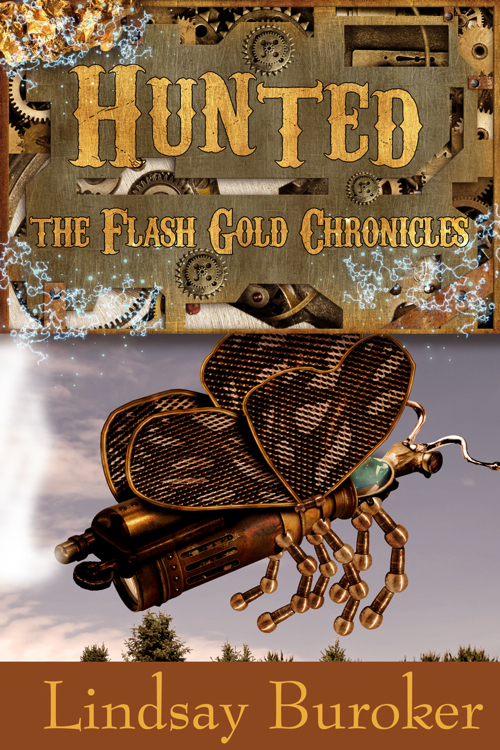
 I’ve been talking about the Flash Gold sequel for a couple of weeks (and showing off the fun cover art), and now it’s finally here!
Hunted is a 27,000-word steampunk novella that stands alone (though you’ll probably want to read the first story before jumping into this one).
Here’s the blurb:
Self-taught tinkerer Kali McAlister is determined to build an airship and escape the frigid Yukon forever. Unfortunately, she’s the heir to the secrets of flash gold, an alchemical energy source that tends to make her a popular target for bandits, gangsters, and pirates.
With the help of her bounty-hunting business partner, Cedar, Kali has outwitted and eluded attackers before, and she thinks she’s prepared for anything. Then her ex-fiancé strolls into her workshop.
As if fooling her once wasn’t enough, he aims to embroil her in a fresh scheme. Meanwhile, a new nemesis is stalking her, a shrouded figure with an arsenal of deadly machines that make Kali’s inventions seem like toys. This time, it’ll take more than her ingenuity and Cedar’s combat skills to survive.
And a nice meaty sample:
Hunted
PART I
A tiny brazier burned on the deck of a foot-long model ship, sending hot air into an oblong patchwork of kerchiefs sealed with a custom paraffin concoction. The balloon expanded until it bulged like an overstuffed sausage casing. The miniature ship rocked on the workbench twice, then rose. Inch by inch, it levitated into the air.
A spool on the deck played out telephone wire that attached to a small control box. Kali McAlister wore a grin brighter than the Northern Lights as she picked it up.
She glanced toward the windows at the front of the workshop. The door was locked and the shutters pulled, but someone wondering why her tinkery was closed might press a nose against a crack….
“Don’t be paranoid,” she told herself. Dawson might have a bustling population compared to Moose Hollow, but she had not been open for business long, and she was lucky to get a customer a day.
Kali flicked one of the four tiny levers on the control box.
A signal pulsed through the telephone wire, and a click sounded inside the hull of the ship. Powered by a flake of flash gold, the miniature engine thrummed to life. Delight coursed through Kali, but anxiety as well. Lots of people suspected she had flash gold, her dead father’s alchemical masterpiece, but only her former beau, Sebastian, and her business partner, Cedar, knew for sure. If anyone caught a glimpse…
“This is necessary,” she told herself. “You can’t build the real thing without constructing a working model first.”
Right. That sounded like a plausible excuse. Anyway, the hull of the ship hid the telltale flash of the vibrant energy source.
With the engine purring like a kitten fat on milk, the model floated higher. Kali flicked another lever. The rudder turned, and the ship changed direction, veering away from the wall and out over her collection of disassembled boilers, half-built projects, and crates of brass, steel, and iron parts. It lofted toward the back corner of the building, skimming beneath ceiling beams decorated with cobwebs and owl pellets. The ex-fur-storage warehouse wasn’t posh, but at least the rent was cheap.
The shop door creaked open, and nippy spring air swirled in, smelling of wood smoke, melting snow, and yeast from the brewery next door.
“Tarnation,” Kali cursed under her breath.
She turned, hoping it was Cedar. It was not.
When she identified the well-dressed man who stepped through the doorway, her hand clenched the control box so tightly she nearly broke one of the levers.
The clean-shaven man wore a tailored black suit, a green silk vest, and a creamy button-down shirt with fancy stitching about the collar. A sleek, beaver-fur top hat perched above a mane of thick blond hair that fell straight to his shoulders. His clear green eyes and easy smile could dazzle a lady…until that lady wised up and realized he was a con man. A con man who could make love to a woman and promise to help her escape the frozen North, all the while scheming to get at her most prized possession.
Kali forced her grip on the control box to loosen so she could turn off the engine. No need to flaunt that prized possession.
“Sebastian,” she growled through clenched teeth. “How’d you get in? I locked that door.”
“Did you?” He slipped something that might have been lock picks or a skeleton key into a pocket, then swept the hat from his head and bowed deeply. “Kali, dear, how are you?”
“How am I?” She gaped at him. “How am I?”
Though she had turned off the model’s engine, the fire still burned, and the unattended airship smacked into a wall. Cursing, Kali raced to the corner and caught it before it fell to the floor. As it was, the wire tangled, creating a mess she would have to unravel later. She dumped out the coals in the brazier and laid the model on her workbench.
“You lied to me, tried to steal my father’s life’s work, and then, when I wouldn’t give it to you, you ratted me out to Soapy Smith and the Scar of Skagway.” Kali slid a hand into a cubby beside the workstation. “Now I’m being hunted more fiercely than the beaver that died for your idiotic hat. And you want to know how I am?” Her fingers closed about cold steel, and she pulled out her favorite weapon.
“Yes, dear, I’m terribly sorry about that.” Sebastian flipped those blond locks out of his eyes and replaced the top hat. “I was a tad angry at the time. After all, you threw one of those smoking shrapnel gewgaws and nearly unmanned me. Can you imagine the egregious horror it would be to my family—and mankind as a whole—if I were not able to one day have chil…” His rambling nonsense came to a halt when he noticed what Kali held.
She stood ramrod straight with her modified Winchester 1873 aimed at his chest. “I reckon I can still make sure you don’t have any children.”
“Ah, Kali, dear.”
“Don’t call me dear.”
“Ah, yes, Kali, then.”
“Ms. McAlister,” she said. “Or ma’am will do. Though you needn’t use either, since I’m inviting you to see yourself out and not bother me again. Ever.”
“Now, now.” He patted the air with his hands. Between the kerosene lamps burning indoors and the daylight seeping through the clouds outdoors, she had no trouble seeing his perfectly manicured nails with not a hint of dirt crusting the beds. “I made a mistake, and I can admit to that. I apologize. I was in my cups and, like I said, recovering from the wounds you inflicted upon me. It really isn’t right to target a man down in that region, you know.”
Her finger tightened on the trigger of the rifle.
He was close enough to see it. “Er, like I was saying, I came to apologize. You must know I didn’t mean for those gangsters to hear about you. I didn’t go to them, I assure you. I was just expressing my displeasure over how things ended.”
“In a crowded bit house with dozens of ears perked your direction,” Kali said.
“Well, that was a tad unwise, for certain, but it’s all a misunderstanding. There’s no reason we can’t get on together again.” He dared to eye her up and down. “You’re still looking mighty fine.”
Kali gaped at him. She wore baggy, grease-stained overalls with tools bristling from every pocket and more gear dangling from her belt. A screwdriver was stuck through the end of her long braid, and sawdust sprinkled her hair, thanks to the final planing she had given the deck of the airship earlier.
“Why don’t you just tell me what you want?” Kali asked. “I’m not the naive girl who fell for your glacier-slick tongue before. I’m older now. Wiser. Mature.”
“Mature? You’re eighteen, and it’s only been four months since I left you.”
“I left you. And nearly blew up your nuts.” She jerked the rifle toward the door. “Now go away.”
“What? You just invited me to tell you what I want.”
“That was a rhetorical question, not an invitation.” Kali sighted down the rifle’s barrel.
“You’re not going to shoot me. You’re a good person.”
She fired.
Sebastian squawked, hurled himself backward, and landed in the muddy quagmire of thawing permafrost outside the door. In an ungainly combination of roll and sideways scramble, he dodged behind the protective cover of the wall.
With the rifle raised, another round automatically chambered, Kali waited for the inevitable return.
A couple of heartbeats passed—she imagined him patting himself down for bullet wounds, despite the lack of pain he had to have noticed—and then another distressed squawk competed with the distant buzz of a sawmill.
“My hat?” Sebastian leaned around the doorframe. Mud spattered his suit, his hair, and smudged his jaw. He thrust his top hat aloft, displaying the daylight now visible through a bullet hole. “That was a little reckless, don’t you think?” Though he tried for nonchalance, the way he kept most of his body out of sight meant he was no longer positive she wouldn’t shoot him. Good.
“You’re right.” Kali lowered the rifle. “When the bullet passed through the hat, it might have hit an innocent passerby.”
“I meant reckless for me! If you’d missed by a half an inch, you could have shot me in the brain.”
“Nonsense. Your brain isn’t that large. I wasn’t even close. Besides, I’m a better shot than I used to be. I’ve been the beneficiary of lessons.” She wondered if mentioning her business partner was a talented bounty hunter would intimidate him—or make him more likely to stay and ask questions. The latter would be intolerable.
“Look.” Sebastian eased inside again, hands spread wide. “Just give me two minutes to explain why I’m here. If you’re not interested in my offer, I’ll leave you alone forever.”
“Without tipping off flash-gold-hunting pirates and thieves on your way out of town?”
He winced. “Kali, I never meant to get those men on your trail. I was just mad and—”
“That dog won’t hunt. Say your piece and absquatulate.”
“I just filed for a claim on Sixty Mile,” Sebastian said. “I want you to help me work it. We’ll split whatever we find.”
Kali stared at him, both because the idea of him “working” was ludicrous and because… “Panning for gold? That’s for fools who don’t understand statistics.”
“Don’t you know how much gold is being found out there right now? Once word gets south, people will be swarming to Dawson. Thousands, maybe tens of thousands. Those who file now will get rich, while those who arrive too late will be lucky to work for bread and salt, mining somebody else’s claim.”
“Prospecting is hard work,” Kali said. “I don’t believe you’ll be out there getting your hands dirty.”
“I’ll be out there. Directing others to get their hands dirty. I’ve already hired a team.”
“Then why do you need me?” she asked.
“To be my engineer. You think I’m going to go at this like some rube straight off the steamer from San Francisco? Panning in the shallows? I’ve got boilers on the way. We’re going to build steam shovels and pumps so we can dig down to hunt for veins. Word around Dawson is you’re the best mechanic around.”
“I see,” Kali said. “You spent three months courting me, and presumably time before that researching me to learn how to get at my father’s secrets, and yet you had to hear from strangers that I’m good with my hands.” The urge to shoot the man spilled into her again.
Sebastian’s lips twitched, as if they were trying to form a scowl, but he forced a smile back into place. “Are you interested or not? Half the gold we pull out of the claim is yours.”
She doubted that would prove true, but even if he was not lying, the answer was the same: “No.”
“I thought you wanted to get out of the Yukon. Here’s a chance. Besides, you’ll be safer in the wilderness if bounty hunters come looking for you. As long as you’re here, anyone in town can direct them to you.”
“A predicament I’m in only because of you.” Kali hefted the rifle again. “Now get out. As you can see, I’m not defenseless. And I already have a plan for getting out of the Yukon. One that’s far more likely to pan out than your gold claim.”
Sebastian scratched his head. “How could you possibly earn the money to go anywhere? Are you joining the girls of the line? You aren’t pretty enough to charge big money.”
Her grip tightened on the rifle. Maybe missing had been a mistake. She wasn’t sure if she was more insulted that he thought the only way a woman could earn money was by whoring or that he didn’t think her bright enough to find another way out of the north.
“Honey, don’t look so shocked. You clean up all right when you get out of those man-clothes, but nobody’s paying more than pennies for half breeds. Ruse or not, you should thank me for spending time with you because no man with teeth, hair, and halfway decent prospects would look twice at someone like you.”
Kali stood so still she forgot to breathe. How was it that he still had the power to make her feel like the sludge in the bottom of a sluice box?
“Problem?” a familiar voice came from outside.
Cedar stepped across the threshold, ducking his head to keep from clunking it on the frame. His broad shoulders filled the doorway, and Sebastian eased back a few steps. Cedar wore clothing practical to the rough-around-the-edges town: deerskin trousers, work shirt, oilskin duster, and a black slouch hat that threw his face into shadows. Kali knew his features by heart, though, and hoped Sebastian felt intimidated when he took in Cedar’s strong square jaw, cool blue eyes, and the scar on his cheek that proclaimed him a survivor of at least one knife battle. Both a rifle barrel and a sword hilt were visible over his shoulder.
“No problem.” Sebastian removed his hat and bowed as deeply as he had for Kali, though he paused on the way up to scowl at the hole in the beaver fur.
“Cedar,” Kali said. “This is Sebastian.” She put enough emphasis on the name to make it clear this was The Sebastian. While she had not shared much of her past with Cedar—being fool enough to get betrayed by a con man was nothing to be proud of—he knew Sebastian was the reason bounty hunters, pirates, and other opportunistic thugs were calling upon her now.
A silent moment passed as Cedar studied Sebastian from boots to top hat.
“Want me to kill him?” he asked.
The offer didn’t surprise Kali so much that she dropped the rifle, but she did fumble it. He was kidding, wasn’t he?
“Uh, pardon?” Sebastian glanced back and forth between them.
“I don’t know,” Kali said, meeting Cedar’s eyes over Sebastian’s head. “Is there a bounty out on him?”
“I could check. After I kill him.”
Sebastian raised a hand. “Are we joshing? I don’t have a bounty on my head. I’m a law-abiding citizen.”
“Yes, apparently swindling women isn’t against the law,” Kali muttered.
“We could tell the Mounties it was a mistake,” Cedar said. “I’ve taken out enough criminals for them that they wouldn’t likely arrest me.”
“Who are you?” Sebastian asked.
“I’m her—”
“Beau,” Kali blurted before Cedar could say business partner.
Then she groaned inwardly, hating herself for the ridiculous impulse. She did not respect women who played games instead of simply speaking the truth, and here she was, trying to look good for Sebastian. Like a woman who could get a man with teeth and hair, thank you very much.
“Yes,” Cedar said, deadpan. “Yes, I am.”
“You?” Sebastian asked with insulting skepticism. “You’re courting her? Why?”
Cedar strolled inside, not-so-accidentally bumping Sebastian with his shoulder on the way past, and joined Kali. Despite the hat shadowing his face, she caught the glimmer of amusement in his eyes. Good. She was relieved. He always seemed to tolerate her wit, if she could call it that, but he had never intimated that they should have a relationship that was anything but professional. Oh, there were days when she thought he was trying to impress her, but the couple of times she had hinted that they might go have a drink at the dancing hall, he had rejected the idea, pointing out that she would be unwise to attend such public venues, given the bounty on her head. She had not had the courage to suggest a private dinner.
“Because,” Cedar said, wrapping his arms around her from behind, “I’d be a fool not to.”
Something clunked against her collar bone. A rock. It dangled on a chain around his neck. She had never seen it before and could not guess why he might wear such a thing. Well, she’d ask later. Now, thanks to her big mouth, she had a part to play.
Kali leaned against Cedar, enjoying the startled expression on Sebastian’s face despite herself. Even through the layers of clothing that separated her from Cedar, she could feel the hard muscles of his chest and arms. He spent a lot of time training to be a capable bounty hunter. The evidence of that training felt nice. All right, more than nice.
“Are you sure you don’t want me to kill him for you?” Cedar asked. “It’d be worth going to jail if it made you happy.”
Sebastian coughed. “Er, I’ll just, uh. I’ll go now. Yes.” He backed out the door. “My offer’s still good if you change your mind Kali!”
The door thumped shut so hard it bounced open again.
A couple of seconds passed before Cedar released her, and she found herself wishing he wouldn’t, but he stepped away, arms dropping. The cold air against her back made her aware of his absence.
Kali turned to face him. “That was…” Nice of you, she thought. Pleasant. Something we should do again without silly pretexts or ex-beaus looking on. “Scratchy,” she said instead. “I hope you shave that stubble before entertaining the ladies at the dancing halls. And why are you wearing a rock like it’s a diamond?”
Cedar’s brows arched.
Kali closed her eyes. She was an idiot. “I mean, thanks for, you know. Helping.”
“You’ve told me enough about what he’s done,” Cedar said. “Reckon I wouldn’t mind tormenting him some for you, though I do need to retract my offer of a killing. I must find Cudgel Conrad and avenge my brother before I do something that could see me hanged or jailed for years.”
“Understandable.” Despite all her threats, she could not find it in herself to wish Sebastian dead anyway. She wasn’t the sort to kill folks, making it strange that she’d partnered up with a bounty hunter, but Cedar’s deal had been too good to resist, and she did not have so many allies that she could turn them away.
“And this—” Cedar lifted the rock and spun it, “—is a lodestone. I won it gambling. It’s supposed to bring luck.”
“If the previous owner lost it gambling, it can’t be that lucky.”
“True, but the chain is silver. I can always sell it.”
Ah, yes, speaking of monetary matters… “Did you find Koothrapai?” she asked, naming a deserter-turned-murderer-and-rapist who had come to Dawson to escape the law. Normally she left the scouting of targets to Cedar, but the thug had wandered past her shop, and she had recognized him from the newspaper.
“Yes,” Cedar said.
“And did you…?” Kali glanced at his sword.
“Yes.”
“And collected the reward money?”
“Yes.”
She waited. This was the point when he usually handed over her share. He did not.
“We’re not splitting this one?” Kali asked. It was understandable, since she had done little to help this time, but Cedar had stipulated a fifty-fifty cut when she first agreed to work with him, modifying his weapons and making useful criminal-thwarting gadgets.
Cedar hesitated before answering. “I did not have need of your services to take Koothrapai down.”
“True, but I did alert you to the man’s presence in town.”
“Which began a three-day hunt, during which I had to traipse all over the valley after a man who served as a scout and knew how to hide his tracks and fight when cornered.”
“Yes, but you like those activities.”
“I do. My argument is that your portion of the work was not commensurate with a fifty percent cut.”
Kali propped her hands on her hips. “Really. Did you use any of my smoke nuts?” she asked, naming the shrapnel-flinging smoke grenades that were one of her trademark inventions.
He hesitated again. “Yes.”
“See, I helped. You just tracked him down. It’s not my fault it took you three days. A trained hound could do that job.”
His nostrils flared and his eyes grew flinty. Even before that, Kali regretted her words. He was her only friend here—one of her only friends in the world.
She rubbed her face. “I’m sorry, but I need money to build my airship.”
“Perhaps,” Cedar said, “in this instance, a nominal finder’s fee would be suitable.”
She closed her eyes, glad he was too mature to lash out at her life’s work the way she had at his. Or maybe she wished he would. It was hard knowing she was the childish one.
“A finder’s fee?” Kali asked, glad she managed a reasonable tone of voice. She almost gave in out of hand, but if she accepted those terms once, might he not try to press them on her every time? If so, it could take her years to reach her goal. “You said we were partners who would split everything fifty-fifty. I came along because you seemed like the best bet for earning the money for the parts and raw materials that can one day get me out of this frozen-eight-months-out-of-the-year hell.”
“Is that the only reason you came with me?” Cedar asked, surprising her. That wasn’t what he was supposed to latch onto.
“What?” she asked. Was he trying to derail her argument? “Of course that’s why I came. What other choice did I have? You cost me any chance of winning that dog sled race and getting my airship money that way.”
“I see.” He sounded disappointed in her.
And that made her bristle more than the money. “I can’t order what I need if all I’m getting are ‘finder’s fees.’ Once I have everything I need, I’ll help you for free while I’m building my airship. That’ll take months. And, listen, if you haven’t found Cudgel in that time, I’ll help you hunt him down.” She tried a smile. “By air.”
Cedar’s eyebrows disappeared beneath the brim of his hat. There, that had him intrigued. “Perhaps,” he said, “but I’m hoping we won’t need that much time. When I was turning in Koothrapai’s head, I ran into an old comrade who gave me a tip.”
He gripped her arms. His eyes burned with an intensity that had not been there during their argument.
“On where to find Cudgel?” Kali asked.
“Possibly.” Cedar noticed his grip and released her. “One of Cudgel’s trusted men, John Wilder—or Wild John as he goes by—just registered a claim up river. His head is worth a couple hundred dollars, but more importantly: when he’s around, Cudgel’s never far off.”
Kali forced a smile, trying to show she was happy for him, but her first thought was that he’d have little reason to stick around and work with her once he’d completed his quest. “Think he’s here, trying to get rich?” she asked. He was probably waiting for her to say something encouraging.
“Must be.” Cedar nodded. “Your old beau is right.”
She winced. She did not want that word associated with her and Sebastian.
“Big finds were made here last year,” he said, “and folks’ll be flooding the town this summer. The population’s already growing.”
“I know. This is all new. My mother’s people had a camp here when I was a girl. Nothing short of gold would make men stupid enough to build a city on land that turns into a swamp when it thaws. I used to—er, wait. You were standing outside, listening to our conversation?” That meant he had heard those insults. The last thing she wanted from him—or anybody—was pity.
“Ah. Well…” Cedar removed his hat and scraped his fingers through his tousled black hair. “When I heard the gunshot, I ran over to check on you. Thought bandits might have invaded the shop. Then, when I figured that wasn’t the case, I wasn’t sure if I should walk in or not.”
“Oh.”
“Are you game to help with Wilder?” he asked.
“Yes,” Kali said, glad to change the subject. “You want to go out and check on his claim, see if he’s about?”
“Yes, but claim jumpers are a problem up here, aren’t they? Folks might get suspicious if we’re roaming about, peering about people’s properties.”
“You think someone is going to mistake me for a claim jumper?” Kali patted her overalls, causing tools to clink and clatter.
“You, perhaps not. But it’s possible folks might think me…” He touched the scar on his cheek.
“Menacing?”
“Dangerous,” Cedar said.
“Dangerously menacing?”
“I’m not menacing. Villains are menacing.”
“You cut people’s heads off, Cedar.”
“I cut villains’ heads off.”
“Which is a menacing practice,” Kali said.
“A noble one. I help bring peace and justice to the world.”
“Menacingly.” She bit her lip to keep a grin from sprawling across her face. She much preferred it when they were not arguing about anything serious.
Cedar stuffed his hat back on his head and glowered at her from the shadows it cast over his face.
“Yes, exactly. That’s menacing.” Figuring he might not appreciate further teasing, she switched the topic. “So, what’s the plan for investigating this Wild fellow’s claim? Want me to pack a bunch of tools and parts in case we need to do anything creative?”
“Wouldn’t you do that whether I wanted to or not?”
“Well, yes.”
Kali looked around, already figuring how much she could stuff into a packsack. She eyed the airship model, wishing she could bring it along, not because it would serve any purpose but because it would be fun to fly it out in the open. Best to lock it up in her hidden, booby-trapped flash-gold vault though. No need to tempt the world.
“After you pack,” Cedar said, “let’s head over to the claims office and see what piece of land your Sebastian filed.”
Kali had turned toward her workbench to gather her gear, but she tripped over her feet at this last comment. “What? Why?”
“He offered you a job, didn’t he? His claim might be close to Wilder’s since they filed at similar times. We could pretend to work for him while spying on the other man.”
“I don’t want to work for him, I want to shoot him.”
“Perhaps we’ll have a gunfight with Cudgel’s men and he’ll get caught in the crossfire.”
“Cedar… This isn’t a good idea. We can’t trust him.”
“We don’t have to. We shouldn’t have to stay there long.”
Kali sighed. “Fine.”
Glass clanked outside the door.
Kali frowned. Was someone out there listening to them?
Before she finished the thought, Cedar had run to the doorway. He stepped outside and paused.
“Someone there?” Kali asked.
“They were.”
She joined him outside before liquid-filled bottles hanging from ropes attached to an eave. The rudimentary “thermometer” had come with the warehouse. The various liquids—mercury, coal oil, Jamaica Ginger extract, and Perry Davis Painkiller—froze at temperatures ranging from forty to seventy below zero, thus providing an indicator of the severity of a winter day. With the warmer spring weather, none were in danger of freezing now, and the contents sloshed inside the bottles, as if some wind buffeted them—or someone had bumped into them.
Cedar pointed to footprints in the mud under the thermometer.
“Sebastian?” Kali guessed.
“Different prints.” Cedar waved to the deep boot marks on the other side of the door, where Sebastian had stood to lean inside. The new ones were no larger than Kali’s own footprints. “Judging by the stride length, the person sprinted away.”
Kali peered up and down the street, wondering if anyone had seen the eavesdropper.
The covered boardwalks fronting the log saloons, gambling halls, and boarding houses were empty. A horse team pulling a wagon struggled with deep mud in the nearest intersection, but the drover, busy with his whip, did not glance her way. Nor did any of the people conversing on the wood porch in front of Gamgee’s Mercantile & Liquor give any indication that suspicious folk had been about.
“I’ll see if I can track him—or her—down,” Cedar said. “Want to pack whatever you’ll need for the trip and meet me at the claim office in an hour?”
“That depends,” Kali said. “When we take down Cudgel, am I getting fifty percent or a finder’s fee?”
“I’d like your full help for Cudgel, which is worth half of the five-thousand-dollar bounty.”
She swallowed. Twenty five hundred dollars? With that kind of money, she could order brand new parts instead of scrounging for used pieces and putting them to creative new uses. She could even hire people to help her assemble her airship. Within the year, she could finish it and be sailing south, over the mountains and far away from icy, dark winters where the sun did not shine for months.
“An hour to get ready?” she asked. “Who needs that much time? I’ll meet you there in thirty minutes.”
Cedar lifted two fingers to the brim of his hat in salute and trotted toward the end of the building where the prints disappeared around the corner. He paused. “By the way…the ladies at the dancing hall like my stubble.”
Before she could decide if she wanted to retort, he jogged out of sight.
* * * * *
If you’re interested, you can grab Hunted at Smashwords, Amazon, and Barnes & Noble (soon to be up in Itunes and other stores). Thanks for reading!
 I finally got around to creating a Facebook fan page this weekend. As far as social-media-sites-I-would-use-even-if-I-weren’t-an-author go, Facebook isn’t anywhere on the list (I don’t find the interface particularly intuitive, and the layout always strikes me as clusterf–, er, mess).


 If you’ve been reading my blog for a while, you may remember that I started thinking of creating a podiobook (audiobook distributed in incremental podcasts/sections) back in February or so. It’s been a while since I mentioned it, so I thought I’d bring you up to date and let you know what the process has been like (the entire book is done now, and we’re going to get the first chapter online in another week or so).