How Author Heather Massey Created a Popular Blog That’s Selling Her Book

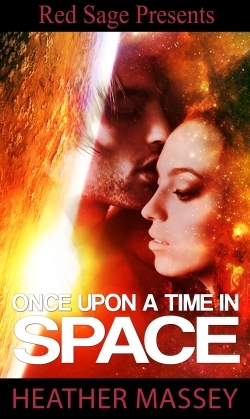
Heather Massey Once upon a Time in SpaceI’ve talked about the benefits of maintaining an author blog before, and also how many of us–myself included!–write to the wrong audience (fellow writers instead of the readers we want to attract) if our goal is to sell books. Heather Massey, the blogger at The Galaxy Express, is one of the few authors I’ve seen who’s doing it right.

She started her blog, which focuses on science fiction romance, and built a popular audience long before her first SFR novel, Once Upon a Time in Space, came out. Thanks to her site, which is visited daily by loyal readers, you can bet she had people lining up to buy the book as soon as it was available.

Heather agreed to answer some questions for us today, so let’s get started!

Why don’t you give us the scoop on your book and on science fiction romance? It’s a genre I enjoy, and certainly one that’s come a long ways of late, but it does still seem like a fairly niche market.

Let’s start with the scoop on science fiction romance. In fact, this subgenre is like the ultimate banana split sundae. You have SF and romance—the bananas—anchoring a wide variety of stories with ooey-gooey fillings like space opera, cyberpunk, military, steampunk, and post-apocalyptic, and biopunk.

Add crunchalicious toppings like heroes and heroines who are scientists, cyborgs, starship captains, bounty hunters, soldiers, and space pirates, and you’ve got the making of a gastronomic masterpiece. Not that I’m biased or anything. 😉

Science fiction romance is indeed a niche market, but one with the staying power of Hercules. While romantic SF harks back to the 1930s, science fiction romance as a subgenre began as Star Trek fan fiction in the 1960s featuring stories about Mr. Spock in love.

In the mid-1980s, romance publishers began releasing science fiction romance, starting with Janelle Taylor’s MOONDUST AND MADNESS and Jayne Ann Krentz’s SWEET STARFIRE. Since then, science fiction romance evolved into a diverse subgenre released by mainstream print romance and SF publishers as well as by small press/digital publishers.

Science fiction romance’s niche status could very well change as ebooks capture an increasingly larger share of the market. Digital publishers like Samhain Publishing, Red Sage, and Carina Press, among others, are leading the charge in terms of getting science fiction romance ebooks into the hands of readers whether they are hardcore fans or newcomers. Readers have choices like never before, from short stories to novellas to novel-length books, and from stories with heat levels ranging from sweet to sizzling.

And now for the scoop about my debut erotic sci-fi romance, ONCE UPON A TIME IN SPACE (Red Sage Publishing). The premise goes a little something like this:

In the sea of stars, an epic love story is about to begin…

Earth is dying. Nick Venture, the last living descendant of Christopher Columbus, embarks on a dangerous mission to find a new planet and save humanity. This places him on a collision course with Raquel Donovan, the deadliest space pirate in the galaxy.

Raquel lives for one purpose: revenge against a horrible demon from her past. When an attempt to hijack Nick’s starship backfires, Raquel becomes his protector in order to avoid capture by the tyrannical Space Defense Corps. Nick and Raquel are irresistibly drawn to one another despite the forbidden nature of their attraction. But the conflicted pirate’s deepest secret could tear the couple apart even as humanity’s time runs out….

Sounds good! Unlike many of the visitors to my blog, you chose to sign on with a publisher rather than doing it indie style. Can you tell us about Red Sage Publishing and what they bring to the table?

For me, the value of a professionally edited story (whether by a freelance editor or one employed by a publisher), is priceless. In order to discover any and all leads on science fiction romance releases, I had been following a number of industry blogs including Edittorrent.

That blog was started by former Red Sage Senior Editor Theresa Stevens and current Red Sage Senior Editor Alicia Rasley. Their posts impressed me with Red Sage’s editing acumen. Also, they had once blogged about their interest in acquiring science fiction romance, and as my story had erotic elements, I decided to submit it. I’ve been absolutely thrilled with the experience.

Another factor is that Red Sage had the reputation and distribution channels that would help connect readers with my book. I simply couldn’t replicate that on my own. Finally, being familiar with the works of Red Sage authors like Nathalie Gray (FULL STEAM AHEAD) and Ellie Marvel (HEAT), I knew Red Sage wasn’t afraid to take risks with edgy science fiction romances. You can’t beat that kind of validation.

I first found out about you through your wonderful blog, The Galaxy Express. There’s just nothing else out there of this caliber in the SFR field. Can you tell us what prompted you to start it? Were you thinking of using it as a base to promote your own books later on, or did it begin out of love for the genre?

Thanks for your kind words about my blog. The basic history behind The Galaxy Express is that I’ve been a fan of SF-romance blends since my early teens. Unfortunately, I was never able to share my interest with very many people. And my day jobs over the years kept me pretty busy.

All of that changed with the birth of my daughter. I had the luxury of becoming a stay-at-home mom. That translated to extra time that I wanted to use for something fun, and that would channel some of my creative energy that had only manifested itself one other time, in a brief spurt of anime fan fiction (science fiction romance, of course!).

Around that same time, I discovered author Linnea Sinclair, whose books and promotional efforts were instrumental in raising the visibility of science fiction romance. Further research yielded the discovery of a few blogs devoted to the subgenre. Some were active, most others were not. Of the active ones, they seemed disconnected, like the proverbial ships passing in the night.

That alarmed me. Science fiction romance is my favorite subgenre and had been for decades. When I started The Galaxy Express, my goal was a selfish one. I wanted to talk about science fiction romance, period. I’d rarely had a chance to have conversations about it at a group level, never mind on the scale the Internet affords us.

Plus, I decided there was strength in numbers. If I could facilitate an entertaining gateway to all things science fiction romance, then the chances were strong that a bona fide community could develop. Basically, I saw a chance to help revitalize the subgenre and I took it.

One exciting aspect about blogging has been the opportunity to connect readers with a wide variety of books. The fact that one of them is now mine is a happy by-product. As I stated earlier, I had written some fan fiction for fun, and I had all kinds of stories in my head, but they were purely for my own entertainment.

I had thought of my book’s premise years before, but I kept hoping someone else would write it so I could read it, LOL! Mysteriously, no authors had the ability to read my mind, so I decided to start developing the story a little more. Then, a lot more. By the time I finished it, ebooks were a serious contender, so submitting to a small press/digital publisher was a no-brainer.

My occupational training was in another field entirely, so for a Muse to bite me this bad surprised me more than anyone.

I’ve seen some guest posts from you around the web. Do you find that’s a good way to build awareness of your blog and your book?

At the risk of sounding ridiculously clichéd, I have a lot of passion for science fiction romance. That passion meant above all that if anyone is going to read my words about science fiction romance, I owe them an entertaining time. If I had to juggle fifty purple hippos wearing lime green tutus and silver pasties while so engaged, then that was an effort I was willing to make.

That passion also empowered me to start relationships with like-minded readers, bloggers, and authors. Building awareness started with building relationships. My blog wouldn’t be where it is today without all of the incredible contributions from readers, bloggers, authors, and publishers.

Guest posts are a terrific way to build awareness, and especially so if they’re entertaining. Readers are busy people. They deserve posts that are fun, provocative, and informative. I strive to offer something fresh each time I have an opportunity to reach out to them.

Do you have any recommendations for authors who want to build a quality blog that attracts their target readers?

While each author’s path will be unique, I reflected upon some factors that folks could harness for a successful blog. In addition to providing entertaining entertainment and building relationships, consider the following:

* Find your niche—nay, your passion!

Presumably, you’ll blog about something you love so much that you’d be a puddle of tears without it. You’re not blogging about a topic/genre because you want to; you’re doing it because you can’t not blog about it. Have fun with it! Write posts in such a way that readers can’t look away. (Now you see where I’m going with this: I’m a poet and didn’t know it—huzzah!)

*Keep your blog’s focus consistent

In a way, a blog is like a brand. In order for readers to obtain a clear sense of the entertainment you’re offering, consistency is key. Once you decide on a topic, keep it pure.

* Commit to your endeavor fully.

Blogging is a lot of work—albeit fun work—and in order to be successful it requires a long-term commitment. I blog on average 3x weekly, and even then there are weeks when it’s a full-time job. Like Yoda said: “Do, or do not. There is no try.”

*Know your S.E.O.

=Search Engine Optimization. Using even a few basic techniques on a consistent basis will help raise your blog’s visibility.

Those are just a few ideas, and there are many, many more out there. But even if I had all the answers, I wouldn’t give them to you. Why? Because the discoveries you’ll make along the way are part of what will make your blog unique. And I do believe that’s a wrap.

Great advice. Thanks, Heather!

Thanks for having me, Lindsay!

For more information, visit Heather Massey’s Web site at www.heathermassey.com. There, you can download a free three-chapter excerpt of ONCE UPON A TIME IN SPACE (multiple formats available). Heather Massey searches for sci-fi romance adventures aboard her blog, The Galaxy Express. She also blogs about the subgenre for Germany’s premier romance magazine, LoveLetter.
Posted in Interviews / Success Stories | Tagged , , , | 11 Comments

How to Make Money as a Book Blogger Part 3: Content and Keywords

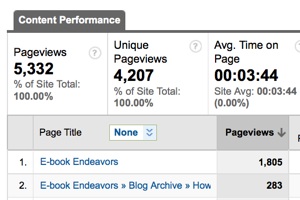
Blog content page performanceWelcome to part three of the series I started with How to Make Money as a Book Blogger Pt. 1 (if you’re coming in new, you may want to start there).
Today we’re talking about choosing a niche for your blog, writing content that attracts book buyers (remember, we’re making money through affiliate links, so we need people to go on and buy books after reading our posts!), and using keywords that will help increase our search engine traffic.

This post isn’t designed to tell you what you have to write, but to help you turn what you want to write into posts people will find. Clear as mud? Good. Let’s get started!

Choosing a genre or “niche” for your blog

When it comes to reading, many of us have preferences for books in certain genres or (for non-fiction) niches. Others like to read across multiple genres, selecting all sorts of books that sound good to them. I don’t want to tell you what you can and can’t blog about, but you’ll do better, insofar as building a fan base and attracting readers goes, by sticking to a specific genre.

It’ll be a rare crowd that shares all your tastes, and people won’t necessarily feel the need to check in often if they’re only interested in a handful of books you blog about. If you blog about an already established genre (and maybe it’s broad such as science fiction and fantasy or narrow such as paranormal romance), you’ve got a ready crowd of folks who already identify themselves as readers of that genre. They can land on a back page of your blog, see from your tagline that you review “cozy mysteries” or “futuristic romances,” and know within seconds they’ve found their kind of place.

With a general book blog, things won’t be as easy because people have to hunt around and see if you’re reviewing things they like, and we just don’t like to waste a lot of time figuring things out. Just think about how quickly you hit your own back button if you can’t find what you’re looking for in the first couple of seconds on a site.

A niche blog with a tagline is going to make things easier all around.

Note:

I’ve seen a lot of new blogs pop up that tote themselves as ebook blogs or indie book blogs. For my money, that’s still too general. Just because I have a kindle doesn’t mean I’m interested in all ebooks; I’m still going to be drawn to SF/F stories. If you want to specialize in covering ebooks or indie books, great, but consider narrowing it further to a specific genre or niche.

Also, with genre-specific book blogs, once you build up an audience, your site will be very attractive to authors looking to advertise. While I talk a lot about affiliate programs, selling advertising can be an even easier way to make money. And, hey, if any of you start high fantasy or steampunk blogs that become popular, come look me up. I’ll be one of your first advertisers!

What to write about on your book blog

We’ve talked about choosing an overarching niche or genre to stick with, but what about specific posts? Naturally, it’s your blog and you can write about whatever you want, but if you want to make some money, it helps to think about what will entice people to go on and purchase the books you’re linking to.

Here are a couple ideas, but don’t let them limit you:

  • Reviews are a great choice, both because they’re just the sort of content people would expect on a “book blog” and also because people reading reviews are likely looking for new books to buy, so why shouldn’t they buy them via your site and your links?
  • Posts that highlight new releases in your genre can also do well. They’re simple to write up too, since, unlike book review posts, they don’t require you to have read the book.
  • Over on my SF/F blog, I’ve had good luck putting together lists of books from specific categories. I’m still selling ebooks from a post I did months ago on 99-cent steampunk ebooks. A tongue-in-cheek list I made of ebooks to help readers survive the zombie apocalypse does well for me too.

Incorporating keywords into your titles and posts

I’ve done a lengthy explanation of keywords and how using them can increase the likelihood of folks finding your blog via search engines, so I’ll do a shorter overview here.

Keywords are the words or, more often, terms people type into search engines such as Google to find what they’re looking for.

For example, if a new book is out and there aren’t many (or any) reviews on Amazon yet, a potential buyer might search for author + book title + review. If you’ve written a post called “A look at the latest by author-name” then you’re not going to be as good of a match (in the search engine’s eyes) as someone who’s entitled their post “Review of Book Title by Author.”

It’s okay to add flair to your titles (and entice folks to click!), but try to hit on the words you think people would actually search for in your titles, and then use those terms a couple more times in the body of your post. You’ll get some bonus love from the search engines if you can get people to link to your post using those keywords (i.e. such-and-such book review), but we’ll talk more about link building later on.

You can tinker around with the Google Adwords Keyword Tool (it’s designed for businesses running Adwords advertising campaigns, but it’s a free way to research keyword frequency on Google). Don’t be discouraged if something like an author’s specific book or even an author isn’t searched that often; that usually means it will be easy to rank at the top of the search engine results because there probably aren’t a lot of people blogging about said term either (at least not people who have a clue about search engine optimization, like you now do!).

For book reviews, it’s pretty obvious what good keywords would be to use, but you can sneak those keywords into other posts as well.

Suppose you did a list of new releases of romance books available for the Kindle. The Keyword Tool tells me “romance novels” is searched more often than “romance books” so I’d probably want to use the more popular term. Stick “kindle” and “ebooks” in your title, too, to attract those specific readers.

Note:

Popular terms (like the two-word terms I mentioned) are harder to rank for, since lots of established, popular sites usually hold the top slots. Three- and four-word phrases are less searched for but easier to rank for.

This is delving a little deeper than you probably need unless you’re the type who enjoys studying statistics and fiddling with this sort of thing. If you just try to use logical keywords in your titles and blog posts, trust me, you’ll be way ahead of most of your peers when it comes to book blogging!

Posted in Blogging | Tagged , , , , , , | 4 Comments

Ebook Authors Can Set up Amazon Author Pages Too

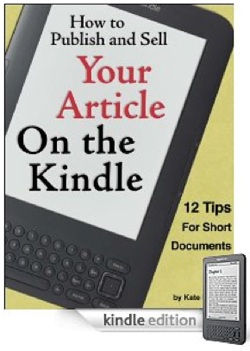
Amazon Author Central PageYou don’t have to be a traditionally published author to have an Amazon Author Page. If you’ve published your ebook for the Kindle store, you qualify as an author as far as Amazon is concerned. If you haven’t set up an author page yet, you’re missing an opportunity to let potential buyers find out a little more about you (and your books!).
What is an Amazon Author Page?

If you go to a book or ebook page on Amazon and click the author’s name, you’ll be taken to their page. Here’s mine: Lindsay Buroker @ Amazon.

If an author hasn’t created a page, a reader clicking that link will simply be taken to the Amazon search results that come up for their name (this can be somewhat unhelpful if there are multiple authors with the same name). If the page has been filled out, they’ll see more information about you, such as your bio, your other available books, and your most recent blog posts (if you add your feed).

How do you set up an Amazon Author Page?

Piece of cake. Head over to Author Central, create an account, wait a couple days for approval, and start filling in the good stuff. You can add your…

  • Books
  • Author picture
  • Biography
  • Events
  • Blog Feed
  • Videos (i.e. book trailers)

People can also start discussions (forum threads) on your author page, so if you want to look popular, talk your friends into coming over and chatting your work up for you. Or ask people who visit your blog to come say something interesting (hint, hint, nudge, nudge).

Thoughts on creating a biography

I’m not the best at writing blurbs about myself, but I made myself fill out a bio. I figure, if nothing else, it’s a chance to sprinkle a few keywords onto my author page. As far as I know, there’s no way for us to track how many visitors find our Amazon author page via the search engines, but it probably doesn’t hurt to list the genre or sub-genre you write in your bio. I worked “fantasy novels” into mine a couple times.

At the least, it’s helpful to let visitors know who you are and what you’re about right off the bat. Book covers themselves don’t always tell the whole story!

For readers who have been-there-done-that, do you have any tips for creating a helpful author page?

Posted in Amazon Kindle Sales | Tagged , | 1 Comment

Kate Harper on Making Money Publishing Kindle Articles

How to Publish Your Article on the Kindle EbookA couple weeks ago, I wrote about e-publishing novellas and short stories as ebooks, since they’re less time-consuming to write than novels. Over in the non-fiction realm, Kate Harper, author of How to Publish and Sell Your Article on the Kindle: 12 Tips for Short Documents, is doing something similar. She publishes non-fiction articles or “booklets” to the Kindle store, and they’re selling well for her.

She’s here today to answer a few questions for other authors who might want to make some extra money with the non-fiction lurking on their hard drives.

What gave you the idea to publish articles as Kindle “ebooks”?

It all all happened by pure accident. I have a girlfriend whose poetry I love, but being the way things are in the poetry world, it’s hard to get published. Since I was a big kindle reader, I encouraged her to consider publishing it on the Kindle instead of trying to knock on New York Editor’s doors. I offered to help her figure out the tech side since I’m more of a techie than her, and then she became enthusiastic. Just so I knew what I was doing, I decided to go through the entire kindle process once by myself (with a short document), so I could better help her with her book.

I pulled an article off my computer to use as a “tester” to publish, and I put it up on Amazon as a Kindle “article” and labeled it that way. I never really thought anyone would ever find it or buy it, but slowly it started selling, which led to more buyers…and this was all with absolutely no marketing. I did not even tell my friends I’d put up the article! Eventually the article became #1 in travel reference. Now it floats around top ten (depending on the day) on both the Kindle and Nook.

That’s great! Can you tell us more about what you’re selling and why these short articles might be appealing to readers?

I realized that I liked buying and reading short documents so I figured other people might be like me. Non-fiction books are filled with a lot of fluff and I’d rather read a 30 page article on the guts of a topic, rather than a 300 page book. Diet books are perfect examples of fluff: 10 pages on the diet guidelines; 290 on recipes.

After my travel article’s unintentional success, I decided to get serious and expand some of my design blog posts into longer articles. Since I work in a specialized career that very few people have written about (licensing art for gift items), I thought publishing articles on that topic would not only be a good idea, but would help a lot of artists who write to me all the time with questions.

After my 6th article I actually learned a LOT because I went from the person always “needing help” on the Amazon Kindle forums to the person always “giving help” on the forums. Then I thought “Hey! I know something here!” Then I thought it would be a great idea for me to write down all the things I knew about publishing and selling Kindle articles, that is not available.

Articles are different than books in many ways. For example, all the Kindle formatting guidelines encourage you to insert a cover page and Table of contents, and other front-matter at the beginning of the document, but for articles that’s a big disadvantage because it wastes precious free sample page space (the first 10% of all kindle books are free), and then the reader can’t even get to your main content to see if they like it.

I show writers how to condense all relevant information on one page, so that the reader can move beyond it quickly, and get to the real content, and hopefully then, they will want to buy the article. There are many other things I learned along these lines.

How are you promoting your work?

Honestly, I don’t know that I am really promoting it in any formal way. I read a lot of blogs and when I run across an article like yours (on Novellas), I think the author would probably appreciate knowing about it and I might send a free copy. But I’ve only done that 3 times at this point! Each person has been quite enthusiastic and supportive (including you!) of what I’m doing. I’m all for creatives helping creatives.

Have you tried selling anywhere else, such as Smashwords or Barnes & Noble?

I do also sell at Barnes and Noble but I don’t use third party services like Smashwords. There are a lot of issues around third party services (that is a whole other conversation). I’d rather see a writer publish one article on Amazon tonight, than to sign up with a third party and go through all the approval process and other complications. If you do it all yourself, you’ll be surprised at how easy it is to do, you will also have complete control over it, and you’ll get higher royalties.

You have a very inexpensive ebook (article!) on this subject, which folks can check out if they’re interested. What does it cover?

Yes, I know .99 cents for 43 pages sound almost free! But I’m also enjoying this entire process. My goal was to write a document that would teach a writer how to publish their article overnight without hiring a tech person or third party.

Everything I talk about has to do with the difference between publishing a Kindle article versus a Kindle book. It does help to know how to price it, sell it, and format it differently than a book. You don’t want someone buying it and being angry because they thought it was a book.

I also have step-by-step “how-to’s” for things that people on the forums get hung up on a lot, such as how to make a clickable Table of Contents links or how to deal with images.

Sounds good. Thanks, Kate!

Thanks so much for asking for this interview. This is a perfect example of how writers help writers!

I’ve since read Kate’s ebook, and it’s well worth the $0.99 if you’re interested in e-publishing some of your own articles. Short but sweet with lots of answers to common questions and links to other resources. Here’s the link to her book again:

How to Publish and Sell Your Article on the Kindle

Posted in Amazon Kindle Sales, Interviews / Success Stories | Tagged , , , , , , | 11 Comments

5 Benefits of Maintaining an Author Blog

to blog or not to blog...A couple weeks ago, I admitted a blog is a time consuming endeavor. I pointed out that, if you only have time to write future books or maintain a blog, publishing more work would probably do more to get you found than blogging. But there are benefits to doing both if you can make the time.

Here are a few reasons why you might want to start a blog if you haven’t already:

1. A blog can help you get noticed.

The big obstacle we’re all facing when we get started, especially as an indie author, is to get found. Until you’re in a bestseller’s list somewhere, it’s unlikely folks are going to stumble across your work.

Every blog post you have out there, however, is a doorway into your world. The more relevant your posts are to your target audience, the more likely they are to find you.

As I’ve mentioned before, I’m not the best example for this, since I’m writing about e-publishing here instead of fantasy-related topics (AKA the stuff that would attract people who might be interested in my ebooks). If you haven’t seen my old post, “Authors, What Should You Blog About?” it may be worth a peep.

2. A blog can become a source of extra income.

When authors start a blog, their sole motivation may be to sell more of their books. Sure, it can do that, but that needn’t be the end of things.

If you work on building up a niche readership and a reasonable amount of daily traffic, there are other ways to make money from your site. I’ve talked about affiliate programs numerous times, and that’s one way to start earning: sign up to be an Amazon, Smashwords, Apple, or Barnes & Noble affiliate and include links to books you talk about on your site. You’ll get a cut if people buy them.

You can also sell advertising to other authors or list your blog in the Kindle store where people can subscribe to it for a dollar or two a month. If you write non-fiction, you can sell courses or products that are audio- or video-related and go beyond ebooks.

Take a look at “Three Ways to Make Extra Money with Your Author Blog” for more details.

3. A blog lets your readers find you and learn more about you.

Sure, there are plenty of stories of reclusive authors who never interact with their fans. But, all things being equal, most of us would rather support real people, and it’s often the ability to follow people’s journeys that make them feel “real” to us.

If you’re not traditionally published (and, perhaps, even if you are), nobody is going to pay for you to go on book tours and visit conventions. Having a place in cyberspace where readers, and potential readers, can find you is the next best thing.

4. A blog gives you an opportunity to help others (who may just help you back).

If you’ve ever guest posted, been interviewed, or had your books written up on someone else’s blog, then you’ve probably been grateful that person gave you the opportunity to get the word out. You might have linked to that blog post from your blog or tweeted about it or mentioned it on Facebook. That helps you, but it also helps the person who owns the blog. You’re essentially helping them promote their site.

If interview, review, or accept blog posts from other authors, they’ll likely do the same for you.

If all you ever do is talk about your own books on your blog, you’re going to have a limited audience, and you’re missing out on the ability to help other people. Altruism aside, people like to do favors for those who have done favors for them!

At the least, you’re increasing the depth of your blog and creating more ways people may find you. I’ve had lots of visitors find my site because they were looking for information on people I’ve interviewed.

5. A blog helps you build a website you may need down the road.

Right now, the royalties for indie ebook authors are attractive, with payouts ranging from 60-85% depending on which retailer your book sells through. Given the fairness of that cut and how popular and trusted the big booksellers are, it seems beneficial for all just to let them handle the selling part of things. But we don’t know what the future holds. Maybe one day, royalties will get slashed to 35%, or censorship or something else will make it less attractive to sell one’s books at these retailers.

If you sell your ebooks on your own site, you’ll keep 100% of the earnings, minus transaction fees. Right now, it may not be worth the hassle, but if things change… who knows? Authors may suddenly decide selling directly to readers is the preferable option. If that happens, you’ll be glad you’ve already built up a following on your site and maybe even started a newsletter, so you have the email addresses of your fans.

There you have it: five benefits of maintaining an author blog. If you have the time, you probably won’t regret blogging!


Posted in Blogging | Tagged , , , | 2 Comments

How to Make Money as a Book Blogger Part 2: Blog Setup

Blog LayoutsAs promised in “How to Make Money as a Book Blogger Part 1,” it’s time to get down to business. Today we’re covering where to start a blog, choosing a user-friendly theme and layout (just say no to excessive widgets, my friends!), and naming categories and posts to create search-engine friendly “permalinks.”

Where to Start Your Book Blog

If you’ve already been blogging for a while, this decision may have been made for you, but if you’re starting from scratch or thinking of doing something new, then read on….

Your choices are to host your blog on a free site, such as Blogger or WordPress.com, or to pay for web hosting, register your own domain name, and run your blog on your own site. I highly recommend the latter for authors, who probably want to do those things anyway to create a professional site to represent their books.

If all you’re going to do is write about other people’s books, sites like Blogger and WordPress are probably fine (I’d stay away from Livejournal and MySpace — among other reasons, they can appear clique-like and uninviting to new visitors). If you’re determined to create an ultra professional site and you could see growing it into more than a blog (i.e. maybe you’ll add a forum or start a podcast down the road), then consider investing in hosting and a domain name. You can get that for less than $100 a year.

Advantages of Setting up Your Blog on a Free Site:

  • There’s no expense involved — This is huge. If you’re not making money yet, and you just want to test the waters with this whole book blogger thing, then it can make sense to wait before deciding to make a monetary investment.
  • It can be easier to network with other bloggers — Blogger, in particular, has a lot of built-in networking features, making it easy for bloggers to interact each other and collect followers through the various widgets.
  • It’s easy to set up and maintain your blog — There’s a wizard to guide you through setup, you don’t have to configure anything, and you don’t need to worry about installing upgrades to the blogging software down the road.

Advantages of Setting up Your Blog on Your Own Site:

  • Total control — While Blogger, WordPress.com, etc. probably aren’t going anywhere anytime soon, there’s no guarantee that they’ll continue to run in a manner you like in the years to come. I’ve certainly seen Livejournal go from decent to annoying with its pop-up ads, and it’s always possible your free host will start implementing measures you don’t like.
  • The ability to expand — As I mentioned, if you host your blog on your own site, it can be a part of your site instead of all there is. You can add a forum, add another feed for a podcast or even a second blog, create a storefront to sell your own ebooks, etc.
  • No need to change later on — If you start with a free blog, you might want to switch to your own hosting and domain name later on. If you spent a lot of time getting links and building up your blog so it ranks well in the search engines, you’re essentially starting over if you move to a new web address.

My web host and blog platform:

I have a couple different types of accounts with different hosts for work and play, and I’d say Blue Host (affiliate link) is the most solid of them. They’re not the cheapest (right now, they have a package that costs $6.95 a month and comes with free domain name registration), but they have better customer service than some of the lower priced ones I’ve tried. Also, they have a “one-click WordPress install,” which makes it easy to get a blog up and running.

WordPress is the most popular blog platform out there, and it’s what I use to run this site and the other blogs I have. It’s free, and it’s updated frequently (good for security purposes), so it’s hard to beat. You can find gazillions of free themes, or you can have a custom one made.

Note: There’s a difference between having a free blog at WordPress.com and running the WordPress software on your own site.

Choosing a Theme and Layout

If you’re on Blogger, you’ll probably just grab one of the themes already available. Easy peasy.

If you install WordPress, you can Google “free wordpress themes” and spend days browsing through all the options. Installing a theme isn’t tough, though you’ll need to be comfortable using an FTP tool. You can always pay a tech-savvy friend to handle everything for you if you decide to go the blog-on-your-own-site route.

As far as choosing a theme, simpler is usually better. You’re welcome to ignore my advice and flex your creative muscles, but having a lot of stuff on a page tends to distract the eye from the important things (like those affiliate links you want folks to click!).

When it comes to colors, dark text on a light background is a lot easier to read than light text on a dark background. When I was younger, I didn’t think anything of reading a white font on a black background at night with the lights off, but I wear glasses these days (probably because of those earlier computer habits…), and I don’t want to read that stuff anymore. Generally, anything that can stand between you and your audience should be avoided.

In regards to awards, widgets, and banners running up and down the sidebars…it’s your call, but, again, simpler tends to be better when the goal is to make money. All other factors being equal, folks like to relax in tidy and uncluttered places rather than chaotic ones.

One last comment here: beware of giant headers.

If you love your huge, artistic header and want to keep it, go for it, but the area “above the fold” (the portion of your blog visible without scrolling down) is considered prime real estate in the web world. It’s what people see first, and that first impression is often what prompts them to stay on a site or click “back.” If the headings of your posts aren’t visible without scrolling down, visitors might make a snap decision that what they’re looking for isn’t on your blog and click away without bothering to explore further.

Name Categories and Creating Search-Engine-Friendly Titles & Permalinks

Categories are important. They allow readers to easily browse to old posts they may be interested, and they also help with search engine optimization (AKA the fine art of ranking in the search engine results for terms related to your posts and blog niche).

Organizing blog posts by month/date doesn’t do anything for your readers or the search engines. Nobody cares when you reviewed the latest epic fantasy bestseller; they just want to be able to find your epic fantasy category and see the books you’ve reviewed there.

With WordPress, it’s easy to create categories. With Blogger, you can use the labels feature to create tag clouds that can serve the same purpose. Just try not to use a lot of obscure labels that will result in a huge cloud that’s not particularly useful for people trying to find things.

If I maintained a book blog on fantasy novels, I’d probably have categories or labels/tags like epic fantasy, steampunk, swords and sorcery, urban fantasy, paranormal romance, dark fantasy, etc.

In addition to using search-engine friendly categories, it’s helpful to choose titles and permalinks that make it clear what the post is about.

By the way, the permalink is the permanent link to your blog post (i.e. …buroker.com/tips-and-tricks/how-to-make-mo…blogger-part-2/). That last part is what will change for each post. Blogger and WordPress will automatically fill this in based on your title, but you can also choose to change it (sometimes I shorten mine if the helper words aren’t important for the search engines).

Choosing titles and permalinks that tell people what the post is about seems obvious, but I see a lot of book reviews that don’t have the author or book title in the title of the post. For people surfing in from the search engines, the title of your post and a tiny snippet from the site is all they see. They’re much more likely to click on a link that clearly offers what they’re looking for (Book Review of Such-and-Such by So-and-So) over one that may or may not have something to do with what they’re looking for.

Also…if you’re not using the title/author in your post title, your site probably won’t appear anywhere near the top of the search engine rankings for that book title anyway. Believe it or not, your best traffic is most likely to come from the search engines (people actively searching for information and reviews for a product are usually doing so because they’re thinking of buying it), so it’s worth putting the effort into attracting those folks.

We’re going to talk more about pleasing those search engines in the next “how to make money” post, in which we’ll take a quick look at keywords and how to integrate them into your posts.

Posted in Tips and Tricks | Tagged , , , , , | 3 Comments

Successful Indie Author Scott Nicholson Talks Advertising in Ebooks and Pricing Concerns

Scott NicholsonToday, we have an interview with Scott Nicholson, the author of thirteen novels and seven story collections, as well as the children’s book If I Were Your Monster. He sells a lot of ebooks, and he’s here to share some thoughts on advertising and how pricing may go in the future. He blogs at Indiereader.com, and you can find out more about his books at www.hauntedcomputer.com.

Do you want to start out telling us about your ebooks and how long you’ve been e-publishing?

I actually dabbled in e-books about six or seven years back through Fictionwise, and after getting a check for $5 every six months, I concluded it was a waste of time. I didn’t change my opinion until late 2009, when I started reading more about the Kindle and was stuck in my career and looking for new challenges. I uploaded my first Kindle book at the very end of 2009, so it’s been just over a year of serious commitment. As the year went on, I entered indie publishing more and more deeply because of the numerous advantages over the old way.

You’ve got several ebooks, all doing fairly well in the Amazon sales rankings. What have you done for promotion?

A little of everything. I try to stay active in various forums and communities, I write about indie publishing and writing, I buy ads like any business, and I study the field a lot. Really, there’s no magic bullet, just a lot of hard work. It helps when people like the books and tell their friends. That’s the best marketing of all, and I truly appreciate my friends and readers, because they create whatever success I have.

Scott Nicholson Childrens EbookYou’ve written a bit about the future of advertising in ebooks. Would you like to talk about that? Do you see ebooks changing to more of a website model where content is given away for free and authors are paid via ad clicks or for sponsored placements?

Honestly, I am a little concerned about the rapid plummeting in ebook prices. But maybe “concerned” is not the right word, because the market creates itself and will resolve itself, and it’s not my problem. All I can do is anticipate and react.

Last year, I predicted that standard ebook prices would be 99 cents by 2015, but now I think it may happen as early as 2012. I mean most fiction works, the stuff that normally would have been mass market paperbacks. Technical books and non-fiction will have higher value and less competition, though a smaller audience in general.

Now I see the ad model coming rapidly, where authors need the downloads to get paid. Clearly that’s where Google wants to take it. And now I may alter my prediction and say that by 2015, most ebooks will be free. I am not sure what this will mean for authors, but I predict a lot of them are going to quit writing, especially the lazy ones who just dragged out their slush pile when the Kindle craze started and never really had the creative passion. They just wanted to be superstars and make money.

If advertising in ebooks does become common place, do you think Kindle/Nook/etc. authors will be able to make money, or will the retailers monopolize things?

Well, the people distributing the books will still need content, so if it’s not worth the writer’s time to spend a year on a novel, you’re either going to get crap (the books people are already giving away for free) or else there will be only a few big powerhouse “names” left. And by “names,” I mean what was already happening in bestselling fiction, where a dozen or so brand-name authors were farmed out, with ghostwriters churning away in the factory. It’s lazy and it’s crap and it contributed to New York’s demise, but I’m not sure what they could have done differently to survive.

And, yes, they are dead, they just don’t know it yet.

So writers need to stay flexible and creative and distributors better make it worth the writers’ time. In other words, if you think things have changed a lot in the last two years, better fasten your seatbelt, because we’ve barely found the pedal on this rocket.

You run the “Indie Books Blog” too. Would like tell us a bit about that? How are you choosing authors you feature?

It’s a labor of love. I know how hard it is to get attention in this crowded arena, so it’s my way of giving back. The theme is “We’re All In It Together,” with the idea that we all promote each other. Some get it, some don’t. I post about one book a day, in the order they are submitted. I may go to paid sponsorships at some point but that would mean working to build it up, and the idea now is the community builds itself. If the community wants it, it will work. If not, at least I planted the seed.

Thanks for visiting with us, Scott!

Thanks, Lindsay.

Posted in Interviews / Success Stories | Tagged , , , | 5 Comments

How to Make Money as a Book Blogger Part 1

Make Money Blogging About BooksThis is the introduction in what will be a series of posts on making money blogging about books and ebooks. My intent is to do about ten posts covering starting a blog, building traffic, and earning money through affiliate programs and selling advertising.

You’re probably not going to be able to retire on the income from your book blog (you can make a lot of money from affiliate marketing, but books, because of their low prices, aren’t the most lucrative things to promote), but I know lots of you guys are blogging about books anyway, either as a means of promoting your own work or because you love to tell people about what you’re reading. As long as you’re putting time into a blog, you might as well make a little money from it, right?

The e-publishing revolution is making this a great time to be a book blogger. I’ve been making money as an Amazon affiliate since 2003, and it’s crazy how much easier it is to sell ebooks than physical products these days. There are no shipping costs for people to get hung up over, and Nook/Kindle/Ipad/etc. owners have already given their billing information to the retailers, so it only takes a click to buy an ebook. All that means it’s easier than ever to make money talking about books.

Note: I’ll be mixing in interviews and posts about other topics while working on this series, so feel free to bookmark this page, as I’ll maintain an ongoing table of contents here, and you can easily click to new posts in the series.

How to Make Money as a Book Blogger Part 1: Introduction
How to Make Money as a Book Blogger Part 2: Blog Setup
How to Make Money as a Book Blogger Part 3: Content and Keywords
How to Make Money as a Book Blogger Part 4: Building Traffic
How to Make Money as a Book Blogger Part 5: Affiliate Links
How to Make Money as a Book Blogger Part 6: Advertising

Now, let’s get started….

What Is a Book Blog?

When I use the term “book blog” in these posts, I’ll be thinking of a dedicated blog that covers books and almost nothing but books, usually in a specific genre. That said, you can certainly apply these tactics to a personal blog where you only mention books some of the time. For example, if you’re an author, you might want to focus on writing and your own work while sprinkling in occasional reviews of books in your genre.

You can certainly make money from a blog where you talk about a variety of topics and use affiliate links now and then, but you’ll find it easier to make a dedicated “niche” blog profitable, if only because it’s easier to promote your site and start ranking for specific keywords in the search engines (more on this later) when you have a focus.

Ultimately, though, what kind of blog you want is up to you. If you’ve already been blogging for a while, there’s no need to start all over. Just use the tactics we’ll cover to increase readership, and consider going back to revamp old posts if you realize they have profit potential (i.e. you posted a book review, but didn’t use an affiliate link to point visitors to a place to buy said book).

How Are We Going to Make Money?

As I’ve mentioned, I’ll put a lot of focus on affiliate marketing, since this tends to be a natural fit with review-style blogs, and many book blogs fall into that category. We’ll talk about other ways to make money, especially via advertising, too, but we’ll spend quite a bit of time on the affiliate scene.

Affiliate marketing is essentially the internet version of working on commission. You sign up for an affiliate program (iTunes, Amazon, Barnes & Noble, and Smashwords all have them), and then you’re able to create links to any page on the merchant’s site. A tracking ID is embedded in the links, so you get credit for any sales that originate from your blog.

The amount of money you earn depends on the terms of the specific affiliate program, but it’s usually in the neighborhood of 5-7% with Smashwords being an outlier. Their default is 11% and some authors choose to “juice” the percentage to attract affiliates. I offer 75% on Emperor’s Edge and Encrypted. The downside is that Smashwords only sells titles by independent authors, so you won’t be able to promote John Grisham or Steven King through them.

You may be thinking 5% on an ebook that costs less than $5 doesn’t seem worth the effort. I’ll admit this whole process may not be worth it to you if you have a lucrative day job, but affiliate earnings do add up, even with the small amounts we’re talking about in regards to books. People often buy more than one book, too, and you’ll get credit for other sales made within 24/48 hours (the length of that window depends on the merchant) of the original click.

Earnings really pick up once your blog becomes popular. If 1 in 100 people who read your book review go on to buy the book, you’re not going to get rich on 25 visitors a day. But if you have 2,500 visitors a day, it’s a different ballgame.

In later posts, we’ll go into specifics on the types of blog entries that work best for selling books as well as when and how to insert those affiliate links.

How Hard Is This? Can Anybody Make Money from a Book Blog?

Well…maybe. The hard part with making money from a blog (any blog) is that you need a substantial number of visitors coming by every day. The more people seeing your posts the more likely someone will buy a book.

We’ll definitely talk about ways to build up traffic, but it is a gradual process. Most people won’t see significant income from their blogs in the first six months. That can be discouraging, but, on the flip side, people who stick with things, posting regularly and promoting their blogs, should start making money eventually. And they won’t just make money on new posts; thanks to the search engines, people will start to find their older posts. The cool thing about blogging is all your posts remain out there and act as doorways to your blog.

Work you do today can pay you two years from now.

The next post will get into the nitty gritty how-to-do-this stuff. We’ll start with choosing a niche and setting up a blog (or possibly modifying one you already have to be more search-engine friendly).

Stay tuned!

Posted in Tips and Tricks | Tagged , , , , , , | 14 Comments