How Well Does Short Fiction Sell in Ebook Form?

A couple of months ago, I did a post called Novellas and Short Stories–Ebooks Not Just for Novels. It turned out to be pretty popular with authors, and why not? It takes a long time to write a novel, so there’s a definite appeal to writing and publishing short works…if they sell.

Do they?

I hope other authors will chime in below, but based on my experience I’m going to say…

Yes. Not as well as full-length novels, but you can find plenty of examples of shorter works doing well in the Kindle Store (and other places as well).

I haven’t tried selling a short story (less than 10,000 words) yet, though my Ice Cracker II is available for free at Barnes & Noble and Smashwords. The minimum price you can list an ebook for is $0.99, and that always seemed a little steep to me for such a short piece of fiction.

However, I did release Flash Gold, an 18,000-word steampunk novella (if you want to be picky, you might call it a novelette) at the beginning of April. It’s my third best seller, after The Emperor’s Edge and Encrypted, and it’s already covered its production costs, thanks to a good deal on cover art and the fact that editors charge by the word (it costs a lot less to have someone proofread a 20,000-word story than a 100,000-word one). That said, some of the reviews do say they wish it was longer (demanding folks, hah!).

In addition to turning novellas and short stories into ebooks, you can also do collections of short stories. I have two of those, and they’re my weakest sellers (especially the children’s one). Of course, I haven’t marketed that one in months, and I haven’t marketed the three-story fantasy collection at all, so that may affect sales.

I think, though, that short story collections or anthologies just aren’t that popular. I have to admit I’m unlikely to buy them. The exception would be if I already knew and liked the characters from a book series and the same characters were in the short stories. (That’s how my fantasy short story bundle works–it features the heroes from The Emperor’s Edge.)

That said, if you have a bunch of short stories collecting dust on your hard drive (maybe you wrote them to submit to magazines and anthologies at one point), you can certainly put them together and turn them into an ebook. I do make some sales with my short story bundles, even if it’s not a lot, and 25 or 50 sales a month can certainly add up over the life an ebook.

I thought I’d poke through Amazon and find a few examples of shorter fiction that’s selling well at the time of this post. To the best of my knowledge, I only picked indie and non-free stories. Check them out for ideas or if you’re just curious to see what’s selling:

There you go: some folks doing well with short fiction!

What are your thoughts on short story, novelette, or novella ebooks? If you’re a reader, do you like buying these shorter works? If you’re an author, are they selling well for you?

Posted in E-publishing | Tagged , , , , | 52 Comments

Preview of Dark Currents (Emperor’s Edge 2) and Other News

Here’s a quick Sunday to post to let you know I’ve uploaded the first chapter of Dark Currents as well as the cover art. The manuscript is off to the editor for proofreading, and I hope to publish it in three weeks or so.

If you haven’t tried the first book, The Emperor’s Edge, yet, I’ve dropped the price to $0.99 to celebrate the release of the second. (Grab it at this price at Amazon, Barnes & Noble, or Smashwords.)

If you already purchased it at $2.99 (thank you!), I invite you to sign up for my newsletter (form in the menu on the right) where I’ll be giving away a Smashwords coupon so you can grab Book 2 for free for the first week it’s out.

I’m also planning to do some kind of contest or giveaway, so stick around for that as well (and if you have any ideas for prizes you’d like to see, let me know, though keep in mind trips to Hawaii and iPads are a little out of my budget).

Posted in My Ebooks | Tagged , , | 4 Comments

How to Get Your Ebook Listed for Free at Amazon (maybe)

It’s no secret that Amazon is currently the biggest marketplace for ebooks. If you can sell well there, you’ve got it made.

As we’ve talked about before, one strategy authors employ is to give away a free or a 99-cent ebook since this can entice readers into trying an unknown author. With luck, they’ll enjoy the first one and go on to purchase your other (regularly priced) ebooks.

But how do you get an ebook listed for free at Amazon? When you list your book through the Kindle Direct Publishing Platform, the lowest price you can input is $0.99.

The following trick has worked for many ebook authors, but not everybody, so be prepared to wait for a while if you give it a try:

How to Get Your Ebook Listed for Free at Amazon

You have to use a backdoor (and there are no guarantees, but Amazon has started making things easier):

  1. List your ebook for free at Smashwords.
  2. Go to the Distribution Channel Manager at Smashwords and opt in to having your ebook distributed to Barnes & Noble (you can tick the Amazon check box, too, but that doesn’t seem to do anything currently).
  3. Upload your ebook to Amazon as normal (via the KDP page) and set whatever price you want.
  4. Sit back and wait for a few weeks. Eventually your ebook will be listed at B&N as a freebie. Sometime after that, Amazon’s bots will notice your work has a lower price elsewhere and price match, thus making your ebook free in the Kindle Store.

If Amazon doesn’t favor you by listing your ebook for free, you can also try putting it on sale.

How to Get Your Ebook Discounted at Amazon

This is a similar process, though with fewer steps.

Ebook listed for sale on Amazon

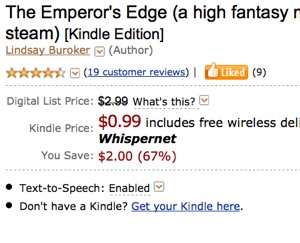
Right now, if you go to Amazon, The Emperor’s Edge is on sale for $0.99 though its “Digital List Price” is displayed as $2.99 while telling folks “You save $2.00.” Going by the psychology behind coupons, this may appear to be a better deal than if I simply listed it for 99 cents. Will it result in more sales? Who knows? But I’m releasing the second book in the series in a few weeks, and I figured it wouldn’t hurt to try and draw in more readers (by the way, if you bought the novel at $2.99, I urge you to sign up for my newsletter, as I’ll be giving away a Smashwords coupon so subscribers can grab Book 2 for free).

But I digress. You’re more interested in getting your work listed for sale.

Just head over to Barnes & Noble and list your ebook for a lower price there than it’s selling for at Amazon. Again, it may not happen overnight, but Amazon should price match eventually and show your ebook as being discounted.

That’s all there is to it. Good luck!


Posted in Amazon Kindle Sales | Tagged , , , , , | 12 Comments

Is Your Website Hurting Your Book Sales?

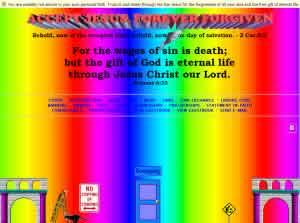
bad website designWhether you sell ebooks or print books, chances are most sales will come as a result of people finding your work on Amazon, Barnes & Noble, Goodreads, etc., but you can sell quite a few as a result of having a blog and/or author website too.
When I mention my ebooks here, I use affiliate links so I know how many sales originate on my site. You can also URL shortening tools, such as Bitly to see how many people click a certain link on your site (i.e. one going to your book at Amazon).

If you’re not selling many, or any, books through your website, then it may be worth asking if something can be improved. I’m not going to talk about big drastic changes that would require hiring a programmer (heck, I have a long list of those types of changes for my own site), but little things we can do to make things easier on readers and possibly increase our conversion rates, aka, how many books we sell through our sites!

Without further ado…a short checklist:

Are book covers and purchase links prominently displayed?

I usually check out author blogs when new writers follow me on Twitter, and I’m often surprised how much clicking and scrolling I have to do to find a link that’ll take me to a book’s Amazon sales page. (Sometimes I never find that link and give up.)

I may be in the minority here, but I don’t want to mess around with widgets to read sample chapters. I own a kindle, therefore I want to go right to the Amazon page (where I can see all the reviews and get an inkling of whether this is worth my time to even try) where I’ll download a sample (I bought an e-reader specifically so I wouldn’t have to read ebooks on my computer).

You don’t have to list links to every bookstore where your ebook can be found, but at least consider Amazon and Barnes & Noble (I do Smashwords, too, since they have ebook formats for everybody under the sun). And remember, the more clicks people have to make to find those sales pages, the more likely they’re going to give up.

Is it clear what genre you write in?

If someone is checking out your site because of a comment you made on Facebook or Twitter, they might not come in with any prior knowledge of you and your work. Consider making it clear right off the bat what genre you write in so people know if they’ve found something they might be interested in. Don’t make them guess by looking at your book covers.

Is your site organized and laid out well?

I know…. Writers are creative, not necessarily organized (I don’t have to look past my own desk to be reminded of that), but a tidy and clutter-free site (no piles of awards, no poorly integrated ads, no menus full of crazy widgets, etc.) is more user-friendly when it comes to navigation.

Also, think twice about doing something horrible to folks without 20/20 eyesight (i.e. white font on a black background). I have to really love you to stick around if the text is making my eyes cross!

Do you have a newsletter?

I’ll be the first to admit I haven’t done much with my own yet (we all have more things on our to-do lists than we have time, don’t we?), but adding a newsletter to your site can be a powerful sales tool. It’s easy for readers to forget about you in the six or twelve months that pass between your last book and the next one you publish. If you encourage fans to sign up for your newsletter, you can shoot them a note when you have a new book out.

You can also send occasional notes about freebies, contests, etc. to keep your name alive in their minds.

Examples Sites

Since my blog isn’t the best example of a good author website (I find myself more interested in writing about e-publishing right now than my work and my genre), I thought I’d find a couple of examples of indie authors doing a good job.They might not do everything I brought up, but overall their sites are clean and easy to navigate (and it’s clear how to buy their books!):

These are just a few things to look at when it comes to site design. Can you think of others? Or do you want to point out any authors doing a good job with their sites? Please, comment below!

Posted in Book Marketing | Tagged , , , , | 14 Comments

7 Reasons You’re Not Selling Many Ebooks

improve ebook salesLet’s do a troubleshooting post today. I’ve had a few emails from new e-publishers wondering how they can sell more ebooks.

If you follow this blog, you know I’m not a huge seller, but my earnings have certainly improved a lot since I got started in December (if I lived somewhere with more affordable housing than Seattle, I might even be making my house payment by now *g*), so I’ll take a shot at offering some advice here. I like lists, so let’s call it…

7 Reasons You’re Not Selling Many Ebooks

1. Nobody knows your ebook exists.

Obscurity. This is what we all struggle with when we’re getting started, especially if we’re coming into this without an established fan base.

I know there are a lot of you out there like me, who feel the story should sell itself, but the truth is we have to work to be found, especially in the beginning. People can’t buy your ebooks if they don’t know they exist. We have to figure out what marketing tactics we’re comfortable with and pursue them, not just for the first couple of weeks our ebook is out but for the months that follow as well.

Some things I’ve had luck with so far:

2. The writing needs work

With ebooks, people can download samples before buying, so if your writing is turning the reader off in the opening chapters, that’s going to be an automatic no for folks.

We writers tend to fall into two camps: we’re either tough critics who are never satisfied with our own work, or we’re perhaps more satisfied than we should be, and it’s a shock when we get bad reviews. I’m firmly in the former camp, so I’m not sure what goes through the minds of folks in the latter, but either way we’re not the best judges of our own writing.

For a litmus test, can you answer yes to the following questions?

  • If you have multiple ebooks out, does your other work occupy the top slots in Amazon’s “Customers Who Bought This Item Also Bought” section? (Granted, if you write in different genres, this test may not be fair, but if people aren’t going on to purchase your other stories, that can be telling.)
  • Are the majority of the reviews positive? (Only those from people you don’t know count.)
  • Do readers write to you to say they enjoyed your work? (Bonus points if they ask about sequels.)

If these things aren’t happening, or occurrences are infrequent at best, it may be a sign that the writing isn’t there yet. E-publishing is easy, and it’s thrilling to see all the success stories out there, but rushing to publish isn’t always a good idea.

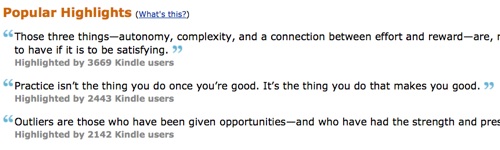
In Outliers: The Story of Success, Malcolm Gladwell pointed out people usually need 10,000 hours to become a true expert at something, and I’ve seen other writers say your first million words are “practice.” It’s not enough just to write a lot either — we have to seek opportunities to learn and improve. Participating in writers’ workshops, where strangers are critiquing your work (and you’re critiquing their work), is a fantastic educational opportunity. Your fellow writers are probably going to be your toughest critics, so when they start telling you your stuff is ready for publication, that’s a good sign.

3. Your cover art and blurb need work

I’m still waiting for the day when I love all my covers and my blurbs are all scintillating, but I’ll get there eventually! If you’re not sure if you’re there yet, ask for feedback from others. At the least, the blurb is easy to change.

If you don’t have a lot of funds to spend on a cover designer right now, save your pennies. I’m not sure this element is quite as important as some people suggest, but it is the potential buyer’s first impression, and you can often tell a self-published book right away based on the cover alone. If it amateurish, people might assume the writing is too.

4. Your work isn’t easily categorized

My two novels fall into this camp, and it’s a bit of a bummer. They’re fantasy, but they don’t qualify as “epic fantasy” or “steampunk” or “historical fantasy” or any other sub-category people search for. This translates to less visibility, because your ebook isn’t appearing in any Top 100 lists, and it’s not coming up when people type their favorite categories into the Amazon search box.

I don’t have an answer to help you with this one, except to suggest picking the “as close as it’s going to get” categories when you’re going through the publication wizard and then tagging your novel with popular sub-categories that maybe sort of kind of apply.

5. Too much front matter before the story starts

As I mentioned, people can and do download samples before buying ebooks. On Amazon, the sample isn’t always that long, especially on a shorter work. If you have a long dedication, a list of other works, a note to the reader, a long license statement, etc., then you may not be giving your readers enough time to get into the story.

6. Your ebook is priced too high

If you have an established fan base, you can get away with charging more for your work, but if nobody has heard of you, you’re asking the reader to take a risk. The higher the price, the most risk.

You probably don’t have to price your ebook at $0.99 (though we’ve discussed some advantages of the 99-cent price point), but many consider $2.99 fair for an unknown novelist. That lets you take advantage of the 70% royalty at Amazon and make $2 per ebook (more than most traditionally published authors will get per book or ebook).

7. You just published your first ebook.

Patience isn’t one of my personal qualities, so I can understand wanting fast results. You hope you’ll be the exception, and your books will take off right out of the gate. It doesn’t usually happen that way though. With most of the success stories we’ve looked at, the authors didn’t sell many ebooks their first six to twelve months until they reached a tipping point (there’s another Gladwell book you can look up) and sales took off.

Many of the successful ebook authors have a large body of work out there too. The more ebooks you have on the virtual shelf, the more ways there are for folks to find you.

All right, that’s seven! Thanks for reading, and I hope this posts helps those who are new to e-publishing. I still have a lot to learn myself and am crossing my fingers for future success for us all.

Update: JA Konrath (bazillionaire traditionally published author turned indie) wrote up What Works: Promo for Ebooks last week, and it’s the most useful post I’ve seen on his blog. It also makes me feel terribly unoriginal for mentioning Outliers. Ah, well. The post is definitely worth a read!

Posted in Book Marketing | Tagged , , | 46 Comments

Authors: How to Track What Readers Are Saying About You

Google AlertsToday’s post is for you authors who are dying to know what people are saying about your work out in the blogosphere (and on Twitter). I must admit, I don’t do much of this because I’m a bit of a coward and prefer to keep my head in the sand, so I’ve linked to several off-site posts with more detailed explanations.

Three ways to track what people are saying about you on the web:

Set up a Google Alert for your name.

This only takes a few seconds and covers most of the bases. Head over to the Google Alerts setup page and enter your name. Add your email address and how often you want messages delivered. Google will send you a note at the desired frequency with links to blog posts and web pages where your name popped up.

Track your name on Twitter

Whether you’re a frequent tweeter or not, you might be curious if anyone on Twitter is talking about you or your books.

The base web interface isn’t the best for tracking keywords (although you can have new mentions sent to your phone), but there are plenty of third-party applications such as Tweetdeck and Hootsuite (free) that do a better job. I have Tweetdeck on my phone, and I can make a column that shows tweets where my last name was mentioned in the last few days. (If you have unique book titles, you could also search for those.)

Here are a few articles from the web with more information on setting things up:

Check incoming links to your site/blog

If you’re lucky, people are linking to you as well as talking about you. With Google Analytics (free), it’s easy to see how people find your site (i.e. if they clicked on a mention in someone’s blog post) and how long they spent on it when they arrived.

There are also tools out there where you can check existing links to your site (these will show up whether anyone’s clicked on them recently or not), though most I’ve tried don’t list all the links. It’s fun to take a peep though. This Yahoo! Pipe let’s you type in your web/blog address and displays the links.

If you’re looking for more ways to track yourself (in the news, on forums, etc.), there’s some good information in How to Track Your Brand Online.


Posted in Tips and Tricks | Tagged , , , , | 7 Comments

How to Create a Print Version of Your Ebook with Reena Jacobs

Reena Jacobs Shadow CatCreating paperback versions of my novels is still on my to-do list (soon!), so I asked Reena Jacobs in to answer some questions. She’s a fellow indie author (see her earlier guest post on “Why I Self-Published“) who went through the process a couple of months ago. You can find links to her work at the bottom of the post, or visit her blog anytime.

Now, let’s get to the questions!

Why do you think it’s important for ebook authors to have print versions of their books available? (I’d love to hear about your giveaway at Goodreads and how that went too).

eBooks are popular these days. In fact, most indie authors profit more through their digital books than print. However, there are readers who are resistant to gadgets. And though I have an eReader, I admit, I’m one of those people. If the digital and print copies are similarly priced, I’ll purchase the print.

To me, it just makes sense to offer a product in as many places as possible, especially if it’s affordable.

As for the Goodreads giveaway, I’d think you’d be tired of hearing me ramble about that one. 🙂 But since you asked, the giveaway was absolutely WONDERFUL. For a debut author, it was a great way for me to get the word out about Shadow Cat.

The giveaway ran for about 30 days. I had a rough start and missed a couple of early days making changes (extending the deadline & adding Canada to the eligibility list). Each time a change is made, the giveaway needs to be reapproved. Since a lot of people only tune in at the start and end of giveaways, I’m sure I missed quite a few opportunities. Still, I ended up with over 700 entrants, and over 60 people added Shadow Cat to their Goodreads list during the giveaway.

The thing with Goodreads is that the prize must be a print book which another reason to publish in paper. The cost to me was less than $9 to send Shadow Cat to the US winner who also happened to leave a review on Goodreads within a few weeks. One nice feature about Goodreads: winners don’t have to leave reviews, but their chances of winning in the future increase if they do. It creates a win-win situation for everyone, in my opinion.

Which publishing outfit did you go with, and why did you choose that one?

I know a lot of people rave about Lighting Source (LSI). However, I went with CreateSpace—mainly for the reason above… cost effectiveness. For many self-published authors, print books are not going to be the stable income. And if we go with the statistics that most authors earn less than $100 with a book then it makes even more sense to go with a low cost way of publishing. This is only heresy, so do your own research, but I’m told LSI can yield a higher royalty, but the start up is costly. For example, a block of 10 ISBNs costs $275 whereas publishers can option for a free one through CreateSpace. Others may feel differently, but at this point in my writing career, I don’t feel the need to own an ISBN, so free works for me. Later down the road, I may change my mind and republish Shadow Cat under my own ISBN.

Typically, the cost to publish with CreateSpace is the price of the proof (usually under $10) plus shipping & handling (less than $4 for ground mail in the US). With a little research, you might find a coupon for CreateSpace to provide the first proof for free, like I did. So essentially, an author could publish with CreateSpace at no cost to them. For the financially challenged, free is good. 🙂

Anytime I want to make a change to Shadow Cat, I simply upload the new version, order a new proof for review (at the cost listed above), and if satisfied, approve the proof.

I went with the extended distribution channels which cost an additional $39. That’s optional, but provides greater royalties, cheaper wholesale costs, and puts the work in more stores and libraries. Would I recommend it? If we use the statistics above (most books make less than $100), I’d say no. But if you have a distorted but optimistic view, like I have for Shadow Cat, then I’d say yes. Haha. Of course, you can always take the wait and see approach and option for it at any time once sales take off.

How is the formatting and cover art different for a paperback book?

Oh my goodness. It’s certainly not as straightforward as ePublishing, especially if one used the Smashwords Formatting Guide for the eBook. With digital, the main concern is eliminating the funky hidden formatting so the distributor receives a clean draft. No worries about page size, headings, page numbers, and so forth—mostly because each reader is different with different settings.

When I published with CreateSpace, it pretty much was what you see is what you get. I didn’t have to worry about the funky hidden formatting. However, I did have to make sure it looked pretty—suppressing page numbers on chapter pages, including page numbers, formatting the work to the actual size of the work.

The cover was a bit simpler. The main concern is making sure the important stuff (images, type, etc) is within the specified margins. If I’m not mistake, 1/4 of an inch from the edge. If one formats the cover art for print the first time, that same cover art can be used for the digital book.

I struggled a bit with formatting the text and cover art. In fact, my first submission was rejected. Even so, it took me less than 24 hours from the time I started formatting Shadow Cat for print until I received final approval (which included that first rejection) and ordered a proof copy.

If you have the $$$, CreateSpace offers services to format your book and even create cover art for it. A less expensive alternative might be to seek out the freelancers in the indie community.

Did you have much say in the pricing, or is it based on word-count/ pages?

I did and do have control of the pricing. However, the associated costs of printing and distributing play a role. CreateSpace allows you to set your own price as long it yields a profit to the publisher (the author if self-publishing). Those interested can find a breakdown in the CreateSpace Understanding Royalties guide. The math is straight forward and far superior to the convoluted explanation I considered giving. haha

Do you want to finish up by telling us about your book and where folks can buy it?

Do I ever! 🙂

Shadow Cat is my debut novel and follows Eric, a CEO of a pharmaceutical company, as he mixes business with a little R&R in the Malaysian jungle. He encounters the native Berani, who unbeknownst to him is also a wehr-tigress. A few mishaps later and Eric finds himself fighting demons, wehr-tigers, and his growing attraction to a female who could disembowel him with one swipe.

Oh… and it has a heat level which has left my mother traumatized for life. 🙂

Readers can find Shadow Cat at the following locations:

Thanks, Reena!

Thanks for having me, Lindsay.

Posted in Tips and Tricks | Tagged , , , | 3 Comments

Pricing Your Ebook at 99 Cents: Pros and Cons

99 centsAs indie authors, we’re able to choose the price for our ebooks, so we can sell them for $10 or $5 or even $0.99. While $2.99 is the lowest you can list your ebook for if you want the desirable 70% royalty rate at Amazon (Barnes & Noble has a similar deal), some authors are finding it worthwhile to sell their ebooks at the lowest possible price point: 99 cents.

Some people are strong proponents for this tactic and others are vehemently against it. I’ll try to stay neutral and present some of the pros and cons today. Ultimately, though, there’s little harm in experimenting, so if you’re thinking of trying it, you might as well!

Advantages of Pricing Your Ebook at 99 Cents

  • At 99 cents, many readers feel there’s little risk in “giving it a try.” Let’s face it: there’s a lot of cringe-worthy stuff out there in the realm of self-published fiction, so readers might think twice about spending more on an unknown indie author.
  • Selling your first ebook at 99 cents can work similar to a “loss leader” in the marketing world, where you take a hit on the first product in order to entice folks to buy your other products (i.e. Book 1 in your six-book fantasy series may be 99 cents, but those who enjoy the first will probably go on to buy the rest, which you can sell at a higher price).
  • For shorter works (i.e. novellas, short story collections, and short stories), this may be a fair price point. Most folks won’t want to pay three bucks for a 10,000-word story, but they may be willing to try it at 99 cents.
  • You may sell more ebooks. This could improve visibility, especially in the Amazon store where your work will start appearing on other books’ pages (in the “Customers Who Bought This Item Also Bought” area). You may also make it into Top 100 bestselling lists for your category. Sales could increase to the point where you’re making more than you were at $2.99 because you’re selling so many more copies.

Disadvantages of the 99-Cent Price Tag

  • You may not sell more ebooks. I can show you plenty of examples of 99-cent ebooks with lousy sales rankings. This can’t be your only marketing strategy.
  • You may lose money. Because of the way royalties are structured at Amazon, you’ll only get 35 cents per sale on a 99-cent ebook while you’ll earn $2.05 on a $2.99 ebook, so you need to sell roughly six times as many copies at the lower price point to make the same amount of money. For some folks, this pricing strategy pays out (especially when they have higher priced second, third, etc. books for readers to go on and purchase). For others, it doesn’t.
  • Your ebook may have a lower perceived value that turns some readers off. While lots of folks like a bargain, I’ve seen others who’ve written blog and forum posts entitled things like, “Why I won’t buy your 99-cent ebook.”
  • Your ego may suffer. I’ve seen quite a few authors cringe at the idea of selling their work for so little, and they’re quick to point out the math and how pitiful a wage they’d be earning at 35 cents per book. (Though most of the equations I’ve seen don’t factor in the unlimited shelf life of an ebook…. The math starts to look better if you assume you’ll be getting sales for years to come.)

There we go: four pros and four cons. I know this list isn’t exhaustive, so feel free to add your own in the comments! Or let us know which side of the fence you’re on. Thanks for reading!

Posted in E-publishing | Tagged , , , , | 33 Comments